In the production of high-end, large-scale castings—such as wind turbine hubs and automotive engine blocks—the synergistic operation of medium-frequency induction melting এবং centrifugal casting (or precision tilt gravity/centrifugal composite casting) is critical for guaranteeing mechanical performance, structural density, এবং ক্লান্তি জীবন. Large castings demand extremely high metallurgical quality, as any minor compositional segregation or temperature deviation can lead to defects like porosity, অন্তর্ভুক্তি, or even catastrophic failure during service.
Below are the core technical points regarding তাপমাত্রা নিয়ন্ত্রণ এবং compositional management during this integrated process:
আমি. Core Process Synergy Mechanisms
- Advantages of Induction Melting
- ইলেক্ট্রোম্যাগনেটিক আলোড়ন প্রভাব: The intrinsic electromagnetic stirring force of medium-frequency আনয়ন চুল্লি achieves high compositional homogeneity, accelerating the dissolution and diffusion of alloying elements.
- Rapid Heating and Precise Temperature Control: High power density enables rapid melting, effectively minimizing high-temperature residence time and preventing alloy element burn-off and gas absorption.
- Coordination with Centrifugal / নির্ভুলতা কাস্টিং
- High Structural Density: Utilizing centrifugal force or efficient feeding mechanisms, the molten metal is subjected to directional pressure during solidification. This thoroughly expels gases and low-density inclusions, substantially improving internal casting soundness.
- Matching Requirements: Furnace capacity and tapping speed must strictly align with the gating and pouring systems to meet the demands of large-batch, দ্রুত, and continuous pouring, thereby preventing cold shuts.
Ii. Key Temperature Control Practices
Temperature is the lifeblood determining molten metal fluidity, solidification microstructure, and final mechanical properties.
| Process Stage | Control Objective | Key Control Measures |
| গলে যাওয়া & সুপারহিটিং | Prevent overheating/overburning; minimize gas absorption | • Strictly control maximum power input to avoid localized overheating. • Dual-calibration using precious metal thermocouples and infrared pyrometers. |
| Pre-Furnace Quick Analysis | Determine optimal tapping temperature | • Measure liquidus temperature and carbon equivalent via thermal analysis. • Adjust compensation factors in real time based on refractory lining condition. |
| Ladle Transfer & Hold | Reduce thermal drop; prevent steep thermal gradients | • Use ladle linings with high thermal insulation and heat retention. • Strictly manage hold times to keep temperature loss within a tight per-minute limit. |
| Pouring Phase | Ensure smooth mold filling and sequential solidification | • Set precise pouring temperatures based on alloy type (যেমন, নমনীয় আয়রন, high-strength alloy steel). • Preheat centrifugal molds or metallic dies to exact targets (typically 150°C – 350°C) to prevent excessive chill layers or cold shuts from cold molds. |
Iii. Precise Compositional Control and Metallurgical Quality
Wind turbine hubs and engine blocks experience complex stress states, placing stringent demands on material purity, nodularization rate (or matrix structure), and micro-alloying.
1. Raw Materials and Charge Management
- High-Purity Charge Materials: Rigorously control rust and oil contamination on recycled charge materials to prevent introducing excessive harmful impurities (যেমন, এস, পি) and gases (এইচ, ও, এন).
- Precise Batching: Leverage electromagnetic stirring for complete homogenization of alloying elements (যেমন, কিউ, মো, সিআর, Ni for reinforcement), ensuring uniform hardness and toughness across the entire cross-section.
2. Slag Practice and Refining Control
- High-Efficiency Fluxes & Refining Agents: Apply composite refining slag during induction melting to effectively absorb non-metallic inclusions (such as silica and alumina) from the melt.
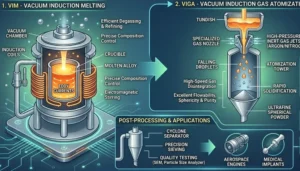
- Vacuum or Atmosphere Protection (When Applicable): For high-end alloy steels or specialized castings, integrate vacuum induction or inert gas protection to curb oxidation at the source.
3. Inoculation and Micro-Alloy Fine-Tuning
- Stream Inoculation or Late-Stage Adjustment: Perform high-efficiency inoculation during tapping and pouring to refine grains. This ensures an optimal balance between pearlite and ferrite ratios in the matrix, fulfilling impact toughness requirements at low temperatures (যেমন, -40° সে) for wind turbine hubs.
IV. Process Matching in Typical Applications
- Wind Turbine Hubs: Characterized by heavy wall thicknesses and complex geometries, requiring exceptional fatigue resistance and toughness. The focus must be placed on compositional uniformity in large-capacity induction furnaces এবং slow/controlled solidification processes to eliminate shrinkage porosity, shrinkage cavities, and graphite flotation in thick cross-sections.
- Automotive Engine Blocks: Thin-walled, উচ্চ শক্তি, and wear-resistant castings. The focus is on achieving exceptionally high iron fluidity এবং extremely low thermal shrinkage tendencies. আবেশন গলনের মাধ্যমে, high-efficiency production of low carbon equivalent, highly alloyed iron is achieved—paired with rapid mold filling to ensure cylinder walls and water jackets remain free of blowholes and chill (সাদা আয়রন) কাঠামো.