1. Evaluating Induction Lines via OEE
In a foundry, focusing solely on tonnage often masks significant hidden costs. OEE (Overall Equipment Effectiveness) serves as the “microscope” that reveals the “Hidden Factory.”
Deep Dive into OEE Components:
OEE = Availability x Performance X Quality
- Performance Loss (The Deep End): Many furnaces run but “stagnate” at low power.
- Cold ব্রিজিং: Incorrect charging sequences cause the bottom to melt while the top remains solid, preventing full power input. This manifests as erratic current fluctuations and a sharp drop in melt rate.
- Idling/Holding Mode: If the metal reaches temperature but waits for lab results or molding line repairs, the furnace enters “Holding Mode.” Holding energy can consume 10-15% of full-load power, which should be flagged as a major performance loss.
- Quality Loss (The Invisible Drain): This isn’t just about scrap; it’s about Over-alloying. If process instability forces you to hit the upper limits of expensive alloys to be “নিরাপদ,” that material variance is a quality-related financial loss.
Management Insight: OEE is not just a percentage; it’s a tool to calculate exactly how much “excess electricity” you paid for to produce one ton of good metal.
2. Predictive Maintenance via Power Curves
An induction furnace is essentially a large resonant circuit. When its physical structure (lining or coil) changes, the electrical signature reacts immediately.
Key Monitoring Metrics:
1. Equivalent Impedance (Z) Drift:
Based on পি = I^2 · R, as the refractory lining thins, the distance between the coil and the melt decreases. This increases mutual inductance.
- The Warning: If the voltage required to maintain constant power drops steadily over days, it is a “smoking gun” for lining wear and potential run-out.
2. Resonant Frequency (f) Jitter:
Modern power supplies automatically track the resonant point.
- The Warning: Sudden, irrational jumps in frequency usually indicate inter-turn short circuits in the coil or an impending capacitor bank failure.
3. প্রতিক্রিয়াশীল শক্তি (VAR) Ratio:
Monitoring changes in reactive compensation. If the compensation current becomes abnormal, the system is “idling” and generating internal heat rather than heating the metal.
| টার্গেট | Signal Characteristic | Predicted Failure |
| অবাধ্য আস্তরণের | Drop in Z / Drift in f | Lining thinning; Leakage risk |
| Inductor Coil | Increased ground leakage current | Insulation aging; Coil sweating |
| Busbars/Cables | Delta T > 20°C at joints | Loose bolts; Poor contact |
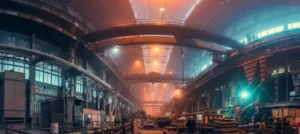
3. Lighting & Visual Fatigue
Lighting is often dismissed as a facility issue, but in the melting zone, it is a matter of visual capture speed এবং biometric response.
Advanced Considerations:
- The Stroboscopic Effect: Low-quality LED or fluorescent lighting can create a flicker that syncs with rotating machinery (like overhead cranes or stirrers), making them appear stationary or reversed. This is a silent killer for crush injuries.
- Visual Adaptation Strategies: Molten metal is extremely bright. If the ambient environment is too dark (contrast ratio exceeding 1:10), operators experience a “blind zone” when looking away from the furnace to the floor.
- সমাধান: বাস্তবায়ন করুন “Gradient Lighting.” Use high-intensity, mid-range color temperatures (4000K-4500K) near the furnace to reduce violent pupil contraction/dilation.
- CRI (Color Rendering Index) & Slag Identification: The visual difference between slag and iron is subtle. ক CRI > 80 allows operators to identify slag boundaries faster, improving removal efficiency and reducing inclusions in the final casting.