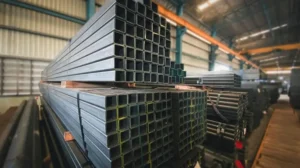
Di industri pengecoran dan metalurgi, besi tua biasanya menyumbang 60% ke 70% of production costs. To an average manager, scrap is just a pile of “trash” with uncontrollable quality. but to a shrewd operator, using the right technology, dia “emas” waiting to be refined.
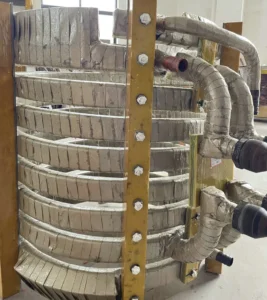
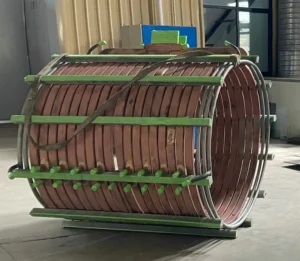
In this “alchemy” proses, itu Frekuensi Sedang Tungku Induksi is the core tool that transforms low-cost raw materials into high-value products, thanks to its unique flexibility and control.
SAYA. Why the Induction Furnace is a “Waste-to-Wealth” Masterpiece
Compared to the Cupola or Electric Arc Furnace (EAF), the induction furnace boasts distinct physical advantages when processing complex scrap, laying the foundation for “Charge Optimization.”
1. Pengadukan Elektromagnetik
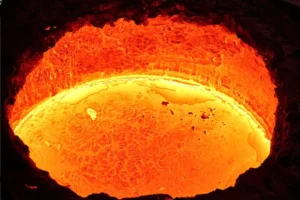
This is the induction furnace’s ultimate weapon. The magnetic field generated by the current automatically stirs the molten metal.
- Keuntungan: Even if you input scrap with vastly different compositions (such as a mix of light, thin scrap and heavy structural steel), the stirring ensures rapid and uniform chemical composition, eliminating segregation. This allows you to more aggressively utilize complex, cheaper scrap.
2. Kontrol Suhu Yang Tepat
- Keuntungan: The ability to control temperature within a very narrow range (MISALNYA., $\pm 5^\circ\text{C}$). This is crucial for minimizing the burning loss (oksidasi) of expensive alloying elements, thereby reducing the cost of “make-up” additions.
3. Flexibility for “Berselang” Production
- Keuntungan: The induction furnace can be started and stopped quickly, and the bath can be easily emptied. This means the same furnace can produce gray iron in one heat, and ductile iron or even high-alloy steel in the next. This flexibility allows companies to quickly respond to market demands and produce high-value orders.
Ii. How to Leverage “Fleksibilitas” to Cut Costs
To turn “trash” ke dalam “emas,” the key is to move away from the mindset of “only buying premium scrap” and instead adopt a strategy of “Low-Cost Scrap + Process Compensation.”
Strategi 1: Itu “Besi Cor Sintetis” Proses
This is the most classic value-added technique in induction melting.
- Traditional Approach: Purchase expensive Pig Iron as the main raw material.
- Induction Optimasi Approach: Use large quantities of inexpensive common baja karbon membatalkan (even turnings and punchings).
- Operation: Add a Rekarburator to the induction furnace. High heat and stirring allow the carbon to dissolve into the steel, artificially synthesizing “Cast Iron.”
- Nilai Conversion: The price of scrap steel is much lower than pig iron. By melting in the induction furnace, you manufacture high-strength castings—often superior to those made with virgin pig iron—using “dirt-cheap” membatalkan.
Strategi 2: Processing “Difficult” Scrap Materials
The induction furnace is quite adaptable to various scrap shapes (provided density is managed).
- Turnings and Light Scrap (Borings & Light Gauge): These are often considered low-grade scrap because they are prone to oxidation and difficult to melt.
- Larutan: Utilize the Tumit Meleleh technique in the induction furnace. A portion of hot molten metal is retained at the furnace bottom, and the light scrap is rapidly pushed below the surface of the liquid metal.
- Hasil: Extremely high recovery rates and significantly lower raw material costs.
Strategi 3: Precise Alloy Micro-Adjustment
By utilizing the low burning loss characteristics of the induction furnace, cheaper forms of alloys can be used.
- Misalnya, directly using Silikon Karbida (Sic) instead of some expensive ferrosilicon not only supplements silicon but also acts as a pre-inoculant, improving the graphite morphology and upgrading the product grade (converting a standard part into a high-strength part).
AKU AKU AKU. The Golden Rules of Charge Optimization
By following the right methods, different grades of scrap can coexist perfectly within the furnace.
1. The Density Ratio Principle
Aturan: Never dump light material into an empty furnace.
- Bottom: Place medium-sized scrap to protect the lining.
- Middle: Add dense, heavy scrap, leveraging its high current induction and fast heating rate as a “heat source.”
- Top/Later Stage: Once a melt pool forms, add light scrap or turnings, using the molten metal to rapidly engulf it and minimize oxidation.
2. Kimia “Addition and Subtraction”
- Dilution Method: If you have a batch of cheap scrap with excessive Sulfur (S) isi, don’t discard it. Blend it with a calculated ratio of low-sulfur premium scrap (or carbon steel). The induction furnace’s stirring ensures perfect integration, bringing the final product’s sulfur content to specifications.
- Utilization Method: If the scrap contains residual Molybdenum (Mo) or Copper (Cu), manage it by category. Deliberately use this scrap when producing high-grade castings that require these alloys, saving the cost of purchasing pure alloys.
Iv. The Economic Equation: How Value is Generated
Let’s look at a simple value conversion model:
| Cost Item | Traditional Model (Reliance on Pig Iron) | Optimized Model (Induction + Scrap Process) | Hasil |
| Main Raw Material | High-priced Pig Iron + Premium Scrap | Inexpensive Scrap + Rekarburator | Raw Material Cost reduced by 20%-30% |
| Alloy Addition | Extensive addition of FeSi/FeMn | Silikon Karbida + Residual alloys in scrap | Alloy Cost reduced by 10% |
| Kualitas Produk | Standar | Unggul (Improved graphite structure) | Selling Price increased by 5%-15% |
| Profit Margin | Thin | High Added Value | Profit Maximization |
V. Kesimpulan
Scrap metal is not inherently good or bad—it is simply a resource that may be in the wrong place. The induction furnace is more than just a metal melting container; itu adalah sebuah “Composition Regulator” dan sebuah “Profit Amplifier.”
By fully utilizing the electromagnetic stirring Dan Kontrol suhu yang tepat capabilities of the induction furnace, you can confidently integrate low-cost scrap, and through scientific batch calculation and carburizing processes, produce high-performance, premium castings. This is the ultimate secret to turning the “trash” in scrap into the “emas” of corporate profit.