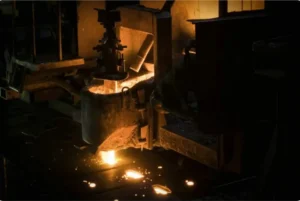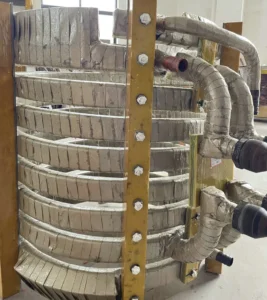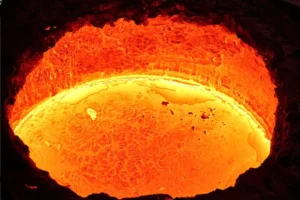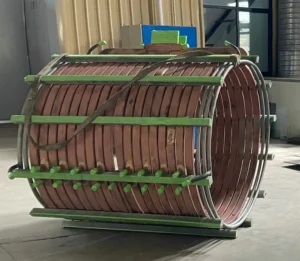
In the field of gas atomization for powder metallurgy, the stability of the bottom-pour induction crucible directly determines the final Distribusi Ukuran Partikel (PSD) Dan sphericity.
This stage is widely regarded as one of the most critical “chokepoints” due to the complex coupling of high-temperature melt, fluid dynamics, and electromagnetic fields.
1. Why are Clogging and Fluctuations Inevitable?
During the atomization process, the melt flows through a delivery tube (nosel) at the bottom toward the atomizer. Two core physical challenges exist here:
- Thermal Imbalance and “Freeze-off”: The delivery tube typically extends outside the furnace body, where it is exposed to extreme heat loss from external cold gas flows (the atomizing medium). If the melt’s memanasi secara keterlaluan is insufficient or the flow rate is too low, the melt will solidify on the inner walls, narrowing the diameter or causing a total “freeze-off.”
- Flow Fluctuations from Static Pressure: Atomization efficiency is highly dependent on the metal stream diameter. Menurut Torricelli’s Law, the exit velocity v is proportional to the liquid level height h.
- As the melt is consumed, h decreases, leading to a drop in flow rate. This destabilizes the Metal-to-Gas (M/G) ratio, causing the powder particles to become coarser over time.
2. Precision Induction Heating
Traditional single-coil setups often fail to provide adequate heat to the bottom nozzle area. Advanced strategies utilize split-zone induction heating:
- Utama vs. Compensation Zones: A primary coil heats the crucible body, while independent micro-induction compensation coils or graphite susceptors are placed around the delivery tube.
- Frekuensi Optimasi: Higher frequencies are used for the bottom nozzle zone to enhance the efek kulit on the delivery tube surface. This ensures heat rapidly penetrates the passing melt to counteract external cooling.
- Thermal Inertia Preheating: Before pouring begins, the delivery tube must be preheated for an extended period to near-melting temperatures to prevent “instant solidification” upon initial contact with the metal.
3. Liquid Level Control and Constant Static Pressure Strategies
To maintain a constant flow rate, the issue of a receding liquid level must be addressed:
A. Continuous Feeding Mechanism
Utilizing a vacuum-sealed feeding system (with vacuum isolation valves), raw materials are added intermittently or continuously during melting. Laser level sensors monitor the melt height in real-time, adjusting the feeding speed to maintain h within a ±5mm variance.
B. Pressure-Assisted Compensation
In a sealed induction furnace, as the liquid level drops, the system automatically increases the back pressure of inert gas at the top of the furnace to compensate for the loss of static pressure.
4. Thermocouple Feedback and Closed-Loop Control
Acquiring accurate temperatures at the bottom nozzle is extremely difficult due to high temperatures, strong magnetic fields, and high flow velocities.
- Multi-point Sensor Layout: High-precision Type B or Type C thermocouples are embedded in the delivery tube wall, often supplemented by redundant infrared pyrometers at the crucible base.
- CascadePID Kontrol:
- Outer Loop: Monitors the bulk temperature of the melt pool.
- Inner Loop: Monitors the wall temperature of the delivery tube in real-time.
- Tindakan: If a downward temperature trend is detected, the PID controller automatically increases the output power of the compensation coil to provide heat before “crusting” occurs.
5. Process Optimization for Anti-Clogging
Beyond thermodynamic control, material and geometric optimizations are vital:
- Nozzle Material Selection: Materials with low wettability relative to the metal melt (MISALNYA., Boron Nitride or Zirconia composites) are used to reduce “skull” buildup.
- Flow Path Geometry: Tapered designs are employed to reduce turbulence at the inlet, preventing sediment accumulation caused by local pressure drops.
- Kontrol atmosfer: Oxygen content must be strictly controlled. The formation of Al2O3 or SiO2 particles is a common trigger for nozzle clogging. Precise vacuum cycles and high-purity argon purging minimize non-metallic inclusions.
Kesimpulan
Solving the bottom-pour crucible challenge requires a shift from empirical control ke precision closed-loop control based on physical modeling. By maintaining both thermal equilibrium (to prevent freeze-off) Dan pressure equilibrium (to stabilize flow) at the nozzle, manufacturers can achieve high sphericity and narrow PSD in high-end metal powders.