In the photovoltaic (PV) and semiconductor supply chains, чистота directly determines wafer minority carrier lifetime, solar cell conversion efficiency, and chip yield.
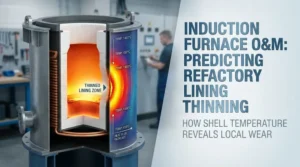
Compared with conventional flame heating, resistance heating, or contact electrode heating, contamination-free high-frequency induction furnaces generate eddy current heating (Джоулево отопление) directly inside the charge via electromagnetic induction.
This enables non-contact heating, контролируемая атмосфера, and localized точность контроль температуры, making them a core piece of equipment for high-purity silicon melting and purification as well as high-purity graphite hot-zone and material processing.
Ⅰ Core Roles in High-Purity Silicon Melting and Purification
Silicon has a melting point of approximately 1414°C and exhibits high chemical reactivity in the molten state, making it prone to reacting with refractories, furnace gases, or electrodes and introducing impurities such as iron, алюминий, бор, фосфор, углерод, и кислород. High-frequency induction furnaces play an irreplaceable role here:
1. Eliminating External Heat Source and Electrode Contamination (Non-Contact Self-Heating)
- Without fuel combustion exhaust gases or direct contact between graphite electrodes/resistance elements and the melt, risks of metal and carbon contamination from combustion byproducts, electrode spalling, and stray currents are significantly reduced.
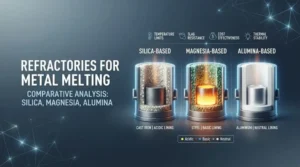
- Paired with high-purity quartz crucibles, cold crucibles (water-cooled copper crucible electromagnetic levitation/directional solidification techniques), or high-purity inert atmospheres (such as high-purity argon) / vacuum environments, кислород, углерод, and transition-metal impurities can be kept to very low levels.
2. Skin Effect and Electromagnetic Stirring for Uniformity and Purification Efficiency
- High-frequency alternating current creates a pronounced кожный эффект near the conductor surface, providing concentrated heating and fast ramp-up rates suited to rapid melting of high-purity silicon feedstock and localized thermal-field control.
- Electromagnetic forces drive natural электромагнитное перемешивание в расплаве, improving temperature and composition uniformity while promoting the transport and volatilization of volatile impurities toward the melt surface—enhancing consistency in directional solidification or float-zone (FZ) purification.
3. Suitability for Polysilicon Ingot Casting, Float-Zone (FZ) Кремний, and Specialty Silicon Preparation
- In high-purity silicon remelting, crystal growth, or silicon-based material synthesis, rapid thermal response and precise power regulation help coordinate thermal-field gradients and reduce thermal stress and dislocation defects.
Ⅱ Core Roles in High-Purity Graphite Processes
It should be noted that graphite has a very high melting point (at atmospheric pressure it does not liquefy and melt in conventional melting furnaces like ordinary metals, undergoing sublimation/phase change at extreme temperatures and specific pressures). Поэтому, in the PV and semiconductor sectors, the core roles of high-frequency induction furnaces for high-purity graphite center on high-purity graphite purification/heat treatment и serving as high-temperature induction susceptors/hot-zone components:
1. High-Temperature Purification and Heat Treatment of High-Purity Graphite (Удаление примесей)
- Isostatic and specialty graphite used in semiconductor and PV hot zones often contains ash and trace metallic elements (например, железо, кальций, магний, бор, и кремний) after forming and baking.
- High-frequency induction heating can rapidly heat graphite to high temperatures under an inert or halogen purification atmosphere, promoting vaporization and evacuation of impurities to achieve low-ash, high-purity semiconductor- or PV-grade graphite materials.
2. Serving as Core High-Temperature, Contamination-Free Hot-Zone Components (Induction Heating Carriers)
- In semiconductor Czochralski/single-crystal furnaces, Силиконовый карбид (Sic) crystal growth furnaces, or high-temperature sintering equipment, high-purity graphite is commonly used as an induction heating susceptor, insulation cylinder, crucible support, or hot-zone structural component.
- Leveraging the precise, clean heating characteristics of high-frequency induction, a uniform high-temperature environment can be achieved inside a strictly atmosphere-controlled chamber while avoiding additional contamination sources from external heating elements.
Ⅲ Key Comparisons and Engineering Considerations in PV and Semiconductor Applications
| Размер сравнения | PV-Grade High-Purity Silicon / Graphite Hot Zone | Semiconductor-Grade High-Purity Silicon / Specialty Graphite |
| Purity Requirement | Solar grade (typically around 6N–9N), balancing cost and throughput | Electronic grade (typically 9N–11N or higher), highly sensitive to metals and dopants |
| Process Focus | Ingot casting / crystal growth remelting, continuous stable hot-zone operation, unit energy consumption control | Float-zone purification, ultra-clean atmosphere control, minimal defects and high uniformity |
| Equipment Priorities | Coil efficiency, water-cooling reliability, crucible/hot-zone service life and maintenance cost | Вакуум / high-purity inert gas tightness, power control precision, particle and cross-contamination prevention |
Key Engineering Selection and Operation Points
- Matching Frequency to Charge Conductivity: Silicon is a semiconductor with relatively low electrical conductivity at room temperature and becomes significantly more conductive once molten; preheating or selecting an appropriate frequency and coupling method is often needed at startup to ensure smooth initial melting and stable power factor.
- Atmosphere and Sealing Synergy: Contamination-free performance depends not only on high-frequency heating itself, but also heavily on furnace sealing integrity, gas purity, vacuum level, and compatibility with crucible or liner materials.
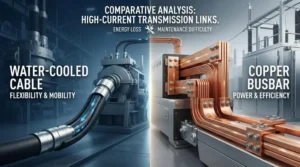
- Cooling and Electromagnetic Shielding Design: Высокая частота, high-current operation brings strong electromagnetic fields and thermal loads, making proper induction coil geometry, water-cooling circuits, and shielding design essential for reliable long-term operation.