Optimizing the charging sequence of a medium-frequency induction furnace is the most direct way to lower energy consumption per ton (kWh/tấn), shorten melting cycles, and extend furnace lining life. The core principle lies in maximizing initial magnetic coupling efficiency while using the liquid metal pool to accelerate heat transfer to solid cold charge materials.
To achieve minimum energy consumption, standard charging operations should strictly follow the spatial sequence of “dense at the bottom, heavy/large in the middle, and loose at the top,” combined with proper feeding timing:
1. Bottom Layer: Bé nhỏ & High-Density Charge Materials
- Subtitle: Establish the initial molten pool and protect the furnace bottom refractories.
- Place smaller, dense, vật liệu sạc sạch (such as punching chips, small pig iron blocks, or heavy stampings) at the bottom of the crucible first.
- Lý do: Small pieces at the bottom quickly heat up via induction and melt to form an initial liquid pool. Ngoài ra, a bottom cushion of small pieces buffers the physical impact of larger, heavy pieces falling onto the refractory lining.
2. Middle Layer: Lớn & Heavy Primary Charge
- Subtitle: Capitalize on the strong magnetic field zone and liquid heat conduction.
- After cushioning the bottom, place the largest and heaviest pieces (such as large steel scrap, trả lại, and risers/runners) vertically or tightly packed in the lower-middle section of the crucible.
- Lý do: The induction coil generates its strongest magnetic field in the middle of the crucible. Heavy charge placed here receives maximum induced current; as the liquid iron level rises from the bottom, liquid heat conduction rapidly accelerates the melting of these heavy cold pieces.
3. Top Layer: Light & Loose Charge
- Subtitle: Form a “thermal cap” to reduce radiation loss.
- Cuối cùng, cover the top with light, thin materials, turnings, sheet steel scraps, or loose pieces.
- Lý do: Loose material at the top acts as a insulating cover, effectively blocking thermal radiation from the hot molten pool beneath. As lower materials melt and sink, top materials are gradually preheated before smoothly falling into the molten pool.
4. Giai đoạn nóng chảy: Small Frequent Additions, Keep Charge Compact
- Subtitle: Absolutely prevent bridging.
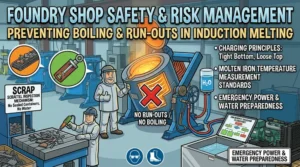
- As power is applied and materials sink, continuously feed new charge to keep the furnace crucible full.
- Lý do: This step is crucial for energy control. Nếu xảy ra hiện tượng bắc cầu (where upper charge jams while lower charge melts completely), the molten iron below will overheat severely. This wastes significant electrical energy and causes severe thermal and electromagnetic stress on the refractory lining.
Additional Operational Details for Maximum Efficiency
- Size Constraints: The maximum diagonal dimension of large charge pieces should never exceed 1/3 ĐẾN 1/2 đường kính trong của nồi nấu kim loại. Oversized charge creates excessive air gaps, lowers packing density, reduces induction efficiency, and leads to jamming.
- Sạc sạch: Materials must be dry and free of heavy rust, dầu, or sand. Moisture vaporization absorbs substantial thermal energy, while sand and rust dramatically increase slag volume—consuming additional power to melt slag and shortening lining life.
- Heel Melting Method (if process permits): If alloy grades remain consistent, retain 10%–20% of molten iron at the bottom (a liquid heel) when tapping. Cold charge for the next heat can be directly submerged into the hot liquid heel, eliminating the time needed to build a new molten pool and significantly reducing power consumption per heat.