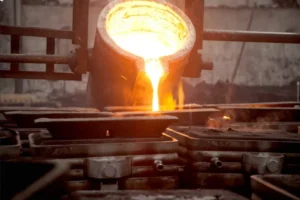
Trong thế giới nhiệt độ cao của sự nóng chảy và sưởi ấm cảm ứng, hệ thống làm mát là “LifeLine” of the equipment. Induction coils and power supply systems have extremely strict water quality requirements; any scaling or blockage can lead to reduced efficiency at best, or a catastrophic coil meltdown at worst.
Here is a detailed technical comparison between Closed Circuit Cooling Towers (CCT) Và Bình ngưng bay hơi (EC) specifically for induction furnace applications.
So sánh cốt lõi: CCT vs. EC
| Kích thước | Closed Circuit Cooling Tower (CCT) | Evaporative Condenser (EC) |
| Đầu tư ban đầu | Vừa phải. Standardized structure with flexible material options. | Cao. Usually utilizes stainless steel or heavy galvanized coils; higher overall cost. |
| Water Saving | Xuất sắc. The internal loop is fully sealed with nearly zero loss. | Tốt. Tuy nhiên, high heat flux leads to slightly higher spray water evaporation. |
| Scaling Resistance | Strong. Stable internal water; external spray water is easy to treat. | Challenging. Higher tube wall temperatures make external scaling more likely. |
| Maintenance Cost | Thấp hơn. Wear parts are standard fans and pumps. | Vừa phải. Dense tube arrays make manual descaling extremely difficult. |
| Environmental Adaptability | Linh hoạt. Supports antifreeze; superior in extreme cold climates. | Niche Leader. Extremely efficient in dry, high-ambient temperature regions. |
Technical Deep Dive
Heat Exchange Mechanism: Sensible vs. Latent Heat
While both use evaporative cooling, their thermodynamic focus differs in induction applications:
- Closed Circuit Cooling Tower (CCT): Primarily relies on sensible heat exchange. The internal soft water carries heat from the furnace and transfers it through the tube wall to the external spray water film.
- Induction Benefit: Provides a very stable “temperature rise curve,” which is crucial for protecting sensitive electronics like IGBT power modules.
- Evaporative Condenser (EC): Focuses on ẩn nhiệt exchange (the energy absorbed during phase change).
- Induction Benefit: During extreme summer peaks (ambient > 38℃), the EC can leverage high evaporation rates to force return water temperatures below the typical furnace alarm threshold (45 – 50oC).
Scaling: Các “Arch-Nemesis” of Induction Coils
Failure in these systems is 90% due to external tube scaling, which creates a thermal barrier, causing the internal loop to overheat.
- CCT (Crossflow/Counterflow): Designed with high spray water flow rates to “flush” the tube walls, preventing dry spots where minerals deposit.
- BẢO TRÌ Lợi thế: Filling and coils are often separated, allowing for easier cleaning of calcium/magnesium deposits without dismantling the whole system.
- EC (Serpentine Coil Design): Coils are packed very tightly to save space. High heat flux can cause “flash evaporation” on the tube surface, leading to hard scale.
- BẢO TRÌ Điều bất lợi: Once the center of the coil bundle scales up, manual cleaning is nearly impossible, often requiring aggressive chemical acid washing.
Nguyên vật liệu & Longevity: Copper vs. Thép
Induction furnaces require low electrical conductivity (tiêu biểu < 50 μS/cm) in the cooling water.
- CCT Choice: Thường xuyên T2 Purple Copper. It offers superior thermal conductivity and excellent corrosion resistance against treated internal water. Life expectancy: 10–15 years.
- EC Choice: Thường xuyên 304/316 Thép không gỉ hoặc Heavy Galvanized Steel. While structurally strong, stainless steel can be susceptible to pitting if the spray water chemistry isn’t perfectly managed. Life expectancy: 8–12 years.
Ma trận quyết định: Which should you choose?
| Scenario | Recommended Solution | Lý luận |
| Large Melting Furnaces (> 5 tấn) | CCT | Prioritizes system stability and long-term reliability. |
| High/Ultra-high Frequency Equipment | CCT | Extremely sensitive to temp fluctuations (requires control within ± 2℃). |
| Space-Constrained Retrofits | EC | More compact footprint and higher integration. |
| Hard Water Regions | CCT | You must have a maintainable structure, or the unit will fail within 2 năm. |
| Energy-Efficiency Benchmarking | EC | Lower fan horsepower requirements per kW of cooling. |
Final Recommendation
- Choose the Closed Circuit Cooling Tower if you want the “safe bet”—it is the industry standard for a reason: it’s robust, easier to fix, and protects the furnace coil over the long haul.
- Choose the Evaporative Condenser if you are an “optimizer” with limited floor space and a top-tier water treatment team on-site to manage scaling risks.
Expert Tip: Never skimp on the spray pump. If the spray system fails, a closed system’s cooling capacity drops by over 80% instantly, and your induction furnace will be “seeing red” (literally) in minutes.