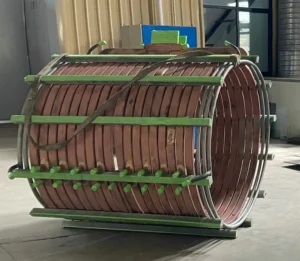
In high-humidity environments or during the monsoon (Plum Rain) season, “sweating”—or condensation—on the surface of induction coils is a critical risk factor. This moisture compromises insulation and can lead to severe inter-turn arcing or short circuits.
The following technical guide outlines the physical principles and preventive strategies to eliminate this risk in industrial foundry operations.
1. The Core Principle: Dew Point Temperature (Td)
To prevent coil condensation, one must master the concept of Dew Point. This is the temperature at which the air becomes saturated with water vapor, causing it to condense into liquid water.
Condensation occurs whenever the temperature of the induction coil (determined by the cooling water) falls below the ambient dew point.
The Logic:
The dew point is a function of ambient temperature (Ta) and relative humidity (RH). Ví dụ:
- If the workshop temperature is 30℃ with 80% humidity, the dew point is approximately 26.2℃.
- If your inlet cooling water is 25℃ in these conditions, the coil will “sweat” ngay lập tức.
2. Preventive Strategies: A Triple-Layer Defense
MỘT. Dynamic Inlet Water Temperature Management (Active Defense)
The most effective solution is to ensure the inlet water temperature is always 3 – 5℃ higher than the ambient dew point.
- Thermostatic Mixing Valves: Install a three-way thermostatic valve in the cooling loop. If the water is too cold, the valve recirculates warm return water into the inlet to rapidly raise the temperature.
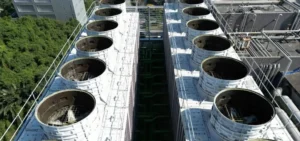
- Operational Thresholds: In humid seasons, adjust the setpoints of closed-circuit cooling towers. Maintaining inlet water between 30℃ and 35℃ typically keeps the coil safely above the dew point without overheating the power electronics.
B. Environmental Humidity Control (Physical Barrier)
If cooling water temperatures cannot be raised (due to high-power dissipation requirements), you must lower the humidity surrounding the furnace.
- Industrial Dehumidifiers: Deploy high-capacity dehumidifiers in the furnace pit or power supply room to maintain a local relative humidity below 60%.
- Pit Sealing: Ensure the furnace pit is properly sealed and waterproofed. Subsurface moisture seepage is a common but overlooked contributor to localized high humidity.
C. Insulation Reinforcement (Surface Protection)
Enhancing the hydrophobicity (water-repelling nature) of the coil reduces the likelihood of water film formation.
- Insulating Coatings: Periodically apply high-grade silicone insulating varnish or “Red Porcelain” (Glyptal) paint. These coatings prevent micro-droplets from forming a continuous conductive path.
- Dust Mitigation: Dust is hygroscopic (it attracts moisture). In humid weather, dust on the coil turns into a conductive sludge. Regularly clean the coil turns using compressed air or industrial vacuums.
3. Operational Maintenance Checklist
| Action Item | Recommended Protocol | Khách quan |
| Water Temp Monitoring | Sync cooling water setpoints with ambient T/H sensors. | Maintain T_{Nước} > T_{dew} |
| Downtime Protection | During long shutdowns, keep water circulating but disable cooling. | Ngăn chặn “cold soaking” the coil |
| Pre-Start Inspection | Check coil surface for moisture before the first melt of the day. | Prevent startup arcing |
| Infrared Scans | Conduct regular thermal imaging of the coil turns. | Identify insulation weak points |