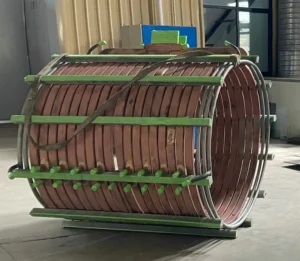
Trong lò nung cảm ứng, molten iron splashing (commonly referred to as “popping” hoặc “eruption”) is not only a cause of metallic loss but also a critical industrial safety hazard. Analyzing the underlying physical and chemical mechanisms is essential for achieving intrinsic safety.
TÔI. Analysis of Fundamental Causes
1. Volumetric Expansion of Moisture and Volatiles
This is the most frequent and dangerous cause. When charge materials containing moisture, dầu, or trapped water enter the high-temperature melt, the liquid flashes into steam instantaneously.
- Physical Mechanism: Water expands by more than 1,600 lần in volume when converting from liquid to gas at high temperatures. If this expansion occurs deep within the melt, the resulting pressure forces the molten iron out of the furnace mouth with explosive force.
- Hidden Risks: Heavily rusted porous scrap, hollow pipes with sealed ends, and pig iron stored outdoors in rainy conditions are all potential “moisture bombs.”
2. Localized Overheating Caused by “Cầu nối”
Bridging occurs when large pieces of charge material become wedged in the upper part of the furnace while the molten pool below continues to be heated by the induction current.
- Risk Logic: The molten iron beneath the “cầu” continues to rise in temperature under high power, potentially reaching its boiling point. If the bridge collapses into the overheated melt or if the vapor pressure beneath the bridge exceeds the structural integrity of the blockage, a violent eruption occurs.
3. Violent Carbon-Oxygen Reaction (CO Boil)
If the oxygen content in the melt is too high and deoxidizers or alloys are added in an improper sequence, a violent chemical reaction can be triggered.
- Chemical Equation:
- [C] + [ồ] → CO ↑
- Physical Manifestation: This reaction typically occurs during the full-melt or high-temperature stages. If a massive volume of CO gas is generated instantaneously and cannot escape smoothly, the melt will surge out of the furnace, similar to a liquid “boil-over.”
4. Structural Defects in the Furnace Hearth or Lining
Improper lining ramming or insufficient sintering often hides significant risks.
- Gas Entrapment: If the vent holes behind the lining are blocked, or if residual moisture/organic solvents remain in the rammed layer, the resulting gas pressure at high temperatures can cause localized lining spalling or gas penetration into the melt, triggering splashing.
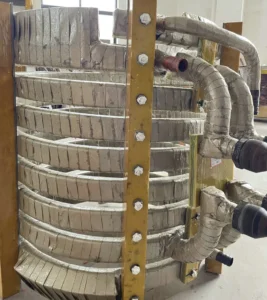
- Precursor to Leakage: Localized gas accumulation can also be a precursor to a “hết,” where molten iron penetrates the lining and contacts the moisture in the coil insulation or cooling system.
Ii. Targeted Prevention Strategies
1. Charge Material Management: “Khô, Clean, and Sized”
- Strict Preheating: All scrap and pig iron should be preheated (typically above 150°C – 200°C) to thoroughly remove surface and interstitial moisture.
- Handling of Sealed Components: It is strictly forbidden to charge sealed pipes or containers; these must be cut open or punctured before charging.
- Classified Storage: Establish rain-proof bunkers and strictly prohibit the direct charging of wet materials.
2. Scientific Charging Protocols
- Charging Sequence: Start with smaller, thinner scrap at the bottom to form an initial molten pool before adding bulkier materials. This pool acts as a thermal buffer to evaporate trace moisture from the upper charge.
- Bridge Prevention: Operators must constantly monitor the downward movement of the charge. If a bridge is detected, the power should be reduced immediately, and mechanical tools should be used to break the bridge safely.
3. Precise Metallurgical Operations
- Deoxidation Sequence: Preliminary deoxidation should be performed before adding alloys that are easily oxidized (such as Manganese or Silicon).
- Bổ sung hợp kim: Avoid bulk additions of alloys with high gas content or those prone to violent reactions; follow the “lô nhỏ, multiple times” nguyên tắc.
4. Lining Maintenance and Monitoring
- Standardized Ramming: Strictly follow the lining ramming process to ensure hearth density and maintain clear vent holes.
- Cold-Start Sintering: When restarting a furnace after a shutdown, strictly adhere to the heating curve to allow for the gradual discharge of any absorbed moisture.
- Alarm Systems: Ensure the ground leak detection and lining monitoring systems are fully functional to track parameters such as coil voltage, nhiệt độ nước, and pressure in real-time.
Expert Insight:
Splashing accidents often stem from a compromise made under production pressure rather than “unknown” factors—such as skipping preheating cycles or taking a gamble on wet baled scrap. TRONG lò cảm ứng hoạt động, safety is rooted in a fundamental respect for every piece of material that enters the furnace.