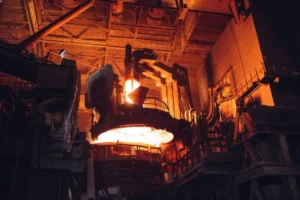
When production lines stop due to molding line failures or auxiliary equipment downtime, molten iron is often forced into a “giữ” state within the induction furnace. While the temperature might remain constant, các metallurgical quality of the iron undergoes a severe degradation.
This phenomenon is known as “molten iron fading.” If handled improperly, even if the subsequent chemical analysis appears within spec, the resulting castings are highly susceptible to chill (Sắt trắng), sự co lại, or sub-standard mechanical properties.
TÔI. Three “Quality Traps” During Prolonged Holding
1. Disappearance of Nuclei and Increased Undercooling (ΔT)
This is the most hidden yet lethal change. Heterogeneous nuclei (such as graphite particles, sunfua, and oxides) are the foundation for promoting graphitization.
- Thermal Dissolution: As holding time increases, the fine residual graphite particles suspended in the melt gradually redissolve into the iron.
- hạt nhân “Poisoning”: Trace elements react with oxygen, altering the surface properties of non-metallic inclusions and stripping them of their nucleating activity.
- Kết quả: The effective number of nuclei drops sharply, leading to a significant increase in eutectic undercooling. Trong quá trình đông đặc, the iron tends toward the metastable white iron system rather than the stable graphite system.
2. Oxidative Burn-off (Primarily Carbon and Silicon)
Even with a furnace lid, oxidation continues at the surface of the melt.
- Carbon Oxidation: Ở nhiệt độ cao, carbon at the surface reacts with oxygen in the air or oxides from the lining:
- C + [ồ] → CO↑
- Trong lò cảm ứng, the carbon burn-off rate during holding is typically around 0.02% ĐẾN 0.05% per hour, depending on the temperature.
- Trôi thành phần: The drop in C and Si leads to a lower Carbon Equivalent (CN), further increasing the risk of shrinkage and hard spots.
3. Increased Gas Pickup (Hydrogen and Nitrogen)
The longer the molten iron is exposed to the atmosphere at high temperatures, the higher the tendency for gas absorption.
- Hydro (H): Moisture in the air or furnace lining decomposes at high temperatures to produce hydrogen.
- Nitơ (N): With extended holding time, nitrogen levels gradually approach saturation.
- Kết quả: As the iron solidifies, gas solubility decreases, leading to subcutaneous pinholes. Cụ thể, if nitrogen exceeds 100 trang/phút, it can cause graphite distortion.
Ii. Mitigation Strategies for “Unexpected Downtime”
When a production stop exceeds 30 phút, an emergency intervention mechanism should be activated rather than simply maintaining temperature.
1. Dynamic Covering and Sealing
- Power Reduction: Switch the furnace to “holding power” (minimum power to maintain temp).
- Slag Protection: Do not deslag too early. Maintaining a thin layer of slag effectively isolates the melt from air, reducing carbon loss and gas pickup. Use a coagulant if the slag volume is insufficient.
- Close the Lid: Strictly enforce lid closure to maintain a stable internal atmosphere.
2. Composition Compensation and “Pre-inoculation”
Before resuming pouring, the melt must be fine-tuned:
- Recarburization: Add an appropriate amount of recarburizer based on the holding duration. Note that “faded” iron has poor “activity,” so stirring is recommended after the addition.
- Enhanced Inoculation: Faded iron requires aggressive inoculation.
- Khuyến nghị cốt lõi: Sử dụng một “Pre-inoculation + Tiêm dòng” dual-mode. Pre-inoculation (in the furnace or ladle) restores the lost base nuclei, while stream inoculation controls the final microstructure.
3. Metallurgical “Sự hồi phục” Testing
Before pouring the first mold, never rely solely on thermal analysis (CN). You must observe a Chill Wedge:
- Monitor Chill Depth: If the white iron width of the chill wedge is significantly wider than during normal production, the nucleating capacity has degraded.
- Hành động khắc phục: Thêm vào 0.1% ĐẾN 0.2% of a long-lasting inoculant (ví dụ., Ba/Ca or Sr-based) or even trace amounts of Sulfur (S) to re-activate nucleation sites.
Iii. Summary Checklist
| Risk Factor | Hiện tượng | Hành động khắc phục |
| Nucleation Drive | Increased undercooling, nuclei dissolution | Intensify inoculation; use long-lasting inoculants (Ba, Sr series). |
| Chemistry | C burn-off, Si fluctuations | Add recarburizers based on burn-off coefficients; use thermal analysis. |
| Gas Content | Increased H and N | Avoid excessive overheating; control pouring temp; reduce turbulent stirring. |
| Solidification | “Cứng” of iron, increased shrinkage | Slightly increase pouring temp by 10°C – 20°C or optimize riser design. |
These strategies will help you avoid batch rejects caused by unplanned outages.