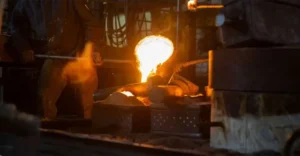
In the world of Đúc đầu tư, choosing between a Tần số trung bình (MF, 1KHz – 20KHz) và một Tần số cao (HF, 20KHz – 100kHz+) induction furnace isn’t about finding the “better” machine—it’s about finding the right “match” for your alloys and material geometry.
Here is a deep dive into the technical differences that will dictate your shop’s melting efficiency and casting quality.
1. The Physics: Skin Effect and Penetration Depth
Các Hiệu ứng da dictates that induced current tends to concentrate on the surface of a conductor. The higher the frequency, the shallower the Skin Depth (δ).
- Tần số trung bình (MF): Offers deeper penetration. Heat is generated further into the core of the metal, making it ideal for melting large-diameter ingots or bulky returns.
- Tần số cao (HF): Heat is concentrated almost instantly on the very surface.
Technical Note: The relationship between skin depth δ và tần suất f is expressed as δ ∝ 1 / √f . If you quadruple the frequency, you halve the penetration depth.
2. Electromagnetic Stirring Force
Induction isn’t just about heat; it’s about movement. This stirring action is vital for chemical homogeneity.
- MF Furnaces (Khuấy mạnh): Lower frequencies produce a powerful electromagnetic force that creates a visible “cái bướu” in the melt.
- Pro: Excellent for mixing in alloying elements (like Cr or Ni) to ensure a perfectly uniform composition.
- Con: Excessive stirring can erode the crucible lining and increase gas pickup or oxidation.
- HF Lò nung (Gentle/Calm Melt): The melt surface remains relatively flat and quiet.
- Pro: Best for volatile alloys or reactive metals where you want to minimize contact with air.
- Con: Poor at dissolving heavy alloy powders or ensuring uniformity in large batches.
3. Material Compatibility: Ingots vs. Fine Scrap
This is where most shops make or break their ROI.
- Các “Ingot Lover” (MF): If your charge consists of large master alloy ingots or heavy “clunky” trả lại, MF is your workhorse. Tuy nhiên, it struggles to “couple” with fine metal chips or powders, often resulting in a failed start.
- Các “Scrap Slayer” (HF): HF is remarkably efficient at heating small particles, thin flakes, or fine powders. In investment casting, if you deal with tiny precision parts or a lot of fine-grained scrap, HF will start and melt much faster.
4. Alloy and Application Comparison
| Tính năng | Tần số trung bình (MF) | Tần số cao (HF) |
| Best For | Thép cacbon, Stainless, Large Copper/Alu | Vàng, Platinum, Dental Alloys, Micro-parts |
| Charge Weight | Typically 5kg to several tons | Typically 10g to 20kg |
| Stirring Action | Strong (Great for alloying) | Weak (Great for delicate melts) |
| Typical Use | Industrial-scale casting | Jewelry, Thuộc về y học, Lab R&D |
| nồi nấu kim loại | Large Ceramic/Refractory | Small Graphite or Quartz |
5. Operational Nuances: Maintenance and Grid Impact
- Crucible Life: Because MF has a stronger stirring force, it physically “washes” the crucible walls more aggressively, often leading to slightly higher refractory wear compared to the gentler HF.
- Power Quality: High-frequency units can introduce more harmonics into your shop’s electrical grid. Hiện đại IGBT-based MF power supplies are generally more robust and offer a power factor of 0.95+ without complex filtering.
Final Verdict: How to Choose?
- Go with Tần số trung bình (MF) if:
- Your typical melt is over 10kg.
- You use standardized master alloy ingots.
- You are casting industrial components (Van, impellers, automotive parts).
- Go with Tần số cao (HF) if:
- You need “lightning-fast” tan chảy (phút, not hours).
- You work with precious metals or high-purity specialized alloys.
- Your castings are tiny (trang sức, dental, or micro-electronics).
Pro Tip: Many modern precision shops use a “Hybrid Strategy”—MF for the main production line and a small HF unit for recycling fine sprue scrap or running small-batch R&D samples.