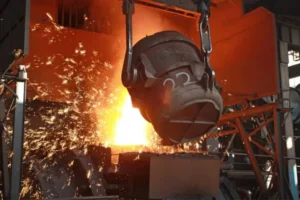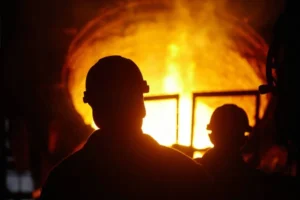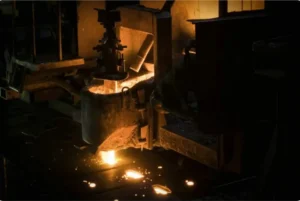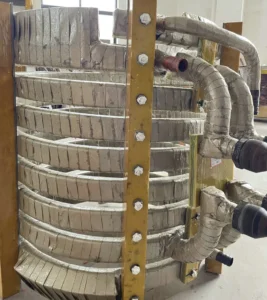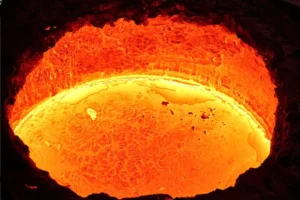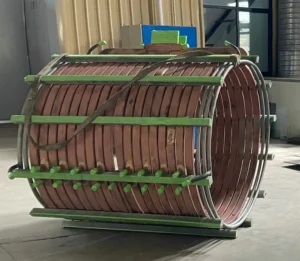
In the production of high-performance metal powders such as titanium alloys and nickel-based superalloys, Vacuum Induction Gas Atomization (VIGA) is the industry-standard process. Các Tần số trung bình Lò nung cảm ứng (MFIF) serves not only as the primary heat source but as the critical “engine” for controlling the metallurgical quality of the powder.
The following is a technical analysis of the MFIF’s core functions and key technologies within a VIGA system:
1. Achieving Ultra-Low Oxygen Content: Vacuum Environment and Degassing
High-purity powders have extremely stringent requirements for interstitial elements like oxygen and nitrogen. The operation of an induction furnace within a vacuum environment provides the following safeguards:
- Vacuum Degassing: Under vacuum levels (typically 10^-1 to 10^-3 Pa), dissolved gases such as hydrogen and nitrogen are removed from the melt according to Sieverts’ Pháp luật.
- Carbon-Oxygen Reaction: For alloys containing carbon, the vacuum environment facilitates the reaction C + O → CO ↑, effectively reducing oxygen levels without introducing external impurities.
- Prevention of Sơ trung quá trình oxy hóa: The entire melting and pouring sequence is conducted under vacuum or an inert gas shroud, completely isolating the melt from atmospheric oxygen.
2. Precise Compositional Uniformity: Khuấy điện từ (EMS)
Medium frequency induction furnaces utilize the principles of electromagnetic induction to generate powerful Khuấy điện từ within the melt.
- Eliminating Segregation: Electromagnetic forces drive vigorous convective circulation, ensuring that alloying elements—even those with significant differences in specific gravity—achieve macroscopic and microscopic homogeneity in a very short time.
- Temperature Field Homogenization: The stirring action eliminates thermal gradients within the crucible. This ensures the melt reaches the tundish at a highly consistent temperature, which is vital for controlling Phân bố kích thước hạt (PSD), as melt viscosity is highly temperature-dependent.
3. The Criticality of Tundish Heating Technology
In a VIGA system, the melt flows through a delivery tube (tundish) toward the atomization nozzle. The temperature control capability of the tundish often determines the continuity of production and the sphericity of the resulting powder.
Key Functions:
- Prevention of “Skull” Formation: Metal melts lose heat rapidly when passing through narrow delivery tubes. Without induction heating to maintain temperature, the melt can solidify on the tube walls, leading to flow fluctuations or nozzle clogs.
- Precise Superheat Control: The atomization process requires the melt to maintain a specific degree of quá nóng. Tundish induction heating compensates for heat loss, ensuring the melt enters the atomization zone at a constant temperature, thereby stabilizing the yield of fine powder.
- Flow Stability: Temperature stability directly dictates the fluid dynamics of the melt. A stable flow rate is a prerequisite for achieving a narrow particle size distribution and reducing the occurrence of irregular or “satellite” powders.
4. Challenges with Reactive Metals (ví dụ., Titanium Alloys)
While VIGA is well-established for superalloys, traditional ceramic crucibles react with molten titanium, leading to contamination.
- Cảm ứng chân không tan chảy – Cold Crucible (VIM-CC): To address this, induction technology is often paired with water-cooled copper crucibles. This utilizes “skull melting” technology to form a protective solid layer of the metal itself, enabling zero-contamination melting while retaining the benefits of induction stirring.
Bản tóm tắt
In a VIGA system, the medium frequency induction furnace is far more than a simple “heater.” Through vacuum dynamic equilibrium, electromagnetic homogenization, and sophisticated tundish thermal management, it creates a highly controllable metallurgical environment. For industrial applications demanding peak sphericity and purity, the precision of induction heating technology directly determines the market competitiveness of the final powder.