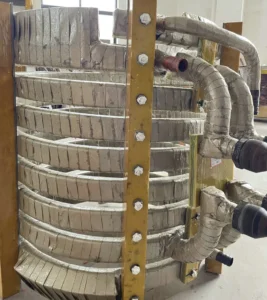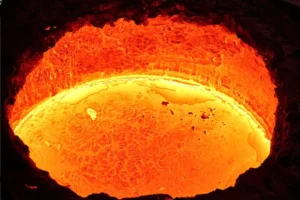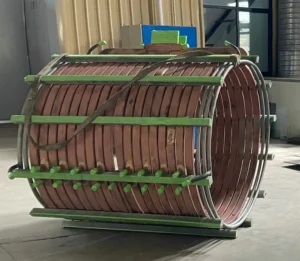
Content Focus: During a total plant blackout, the molten iron within the furnace continues to emit massive amounts of heat due to thermal inertia. If the cooling water supply stops, the induction coil will be scrapped instantly. How to design a reliable power-off protection water circuit.
This is a critical and high-risk industrial safety topic. In the operation of an Induction pugon, a total plant blackout is one of the most dangerous operating conditions.
As you noted, although the power source is cut, the tons of molten iron inside possess immense Thermal Inertia. If the cooling water circulation stops, the residual water inside the copper coil will vaporize within seconds. This leads to vapor lock (gas blocking the flow), coil overheating and deformation, insulation burnout, and potentially a catastrophic Furnace Run-out (molten metal penetrating the lining to contact water), causing an explosion.
1. Core Risks: Thermal Inertia & Time Windows
Before designing the emergency system, we must define the physical challenges:
- Heat Transfer Direction: During normal operation, cooling water removes Joule heat generated by the coil. After a blackout, the primary heat source shifts to the radiant and conductive heat transferring outward from the molten iron.
- Critical Time Window: The first 15-30 minutes after a power outage are the most dangerous. This is when the furnace lining temperature is highest, and heat transfer to the coil is most aggressive.
- Phase Change Risk: If water flow stops for even a few dozen seconds, the water temperature in the coil can rise above, generating steam. The expansion of steam causes a “Vapor Lock” effect, blocking subsequent water flow and causing total system failure.
2. Solution A: The High-Level Gravity Tank — Passive Defense
The gravity tank is the most reliable “First Line of Defense” because it relies on physics (gravity) and is immune to electrical system failures.
2.1 Key Design Specifications
- Installation Height (Head):
- Principle: The bottom of the tank must be high enough to overcome piping resistance and ensure turbulent flow within the coil.
- Rule of Thumb: Generally requires the tank bottom to be 10-15 meters above the furnace deck.
- Calculation: Every 10 meters of drop provides approximately 1 bar of static pressure. Induction coils usually require full flow, so while gravity alone may not provide full rated flow, it is sufficient to prevent boiling.
- Kapasidad (Duration):
- Standard: Must ensure continuous water supply for at least 30-60 minutes, until the furnace charge naturally cools to a safe temperature or the diesel pump stabilizes.
- Estimation: Emergency flow is typically 20%-30% of normal flow.
- Water Quality: Must be softened or pure water. The tank should remain full (wet standby) with a float valve for automatic refilling.
2.2 Pros & Cons Analysis
- Pros: Zero start-up time (millisecond response), zero failure rate (gravity never fails), no human intervention required.
- Cons: High structural requirements (load-bearing), water pressure decreases as the level drops, limited capacity.
3. Solution B: The Diesel Emergency Pump — Active Defense
The diesel pump set is designed to provide long-duration, high-pressure cooling water, serving as the “Second Line of Defense.”
3.1 Key Design Specifications
- Start Logic:
- Must be equipped with an ATS (Automatic Transfer Switch) controller. Upon detecting a grid failure or loss of main pump pressure, the diesel engine must auto-start and reach rated speed within 15-45 seconds.
- Batteries must be redundant (one active, one standby) with grid-powered float chargers to ensure readiness.
- Flow & Head:
- Head: Should be close to the main circulation pump to overcome coil resistance.
- Flow: Can be slightly lower than the main pump, but recommended not to be less than 40-50% of normal flow.
- Bypass Design: The diesel pump inlet/outlet should be parallel to the main pipeline and kept in “Wet Standby” mode (pump casing filled with water) to prevent dry starting.
3.2 Pros & Cons Analysis
- Pros: Supply duration is limited only by the fuel tank (can run for hours), stable pressure.
- Cons: Mechanical failure risk (start-up failure), requires regular maintenance (test runs), exists a start-up gap of several seconds.
4. System Integration: Best Practice Architecture
The safest design is not “either/or,” but a “Gravity Tank + Diesel Pump” Combination.
4.1 Switching Logic Sequence
- Normal Operation: Electric main pump runs; check valve closes the emergency circuit.
- Blackout Instant: Main pump stops; network pressure drops rapidly.
- Phase 1:
- Gravity Tank Intervenes: The Pneumatic Shut-off Valve (Normally Open / Fail-Open type) o Hydraulic Check Valve on the emergency line opens immediately.
- Gravity flow fills the pressure vacuum instantly, preventing coil water vaporization.
- Phase 2:
- Diesel Pump Takeover: The diesel engine starts successfully and builds pressure.
- Since the Diesel Pump pressure (hal., 4 bar) is higher than the Gravity Tank static pressure (hal., 1.5 bar), the check valve closes the tank line, and the Diesel Pump takes over automatically.
- Drainage Path: Emergency return water usually bypasses the cooling tower (high resistance, no fans running) and discharges directly to an emergency pool or drain (Open Loop Cycle) to minimize backpressure.
4.2 Key Valve Selection
- Inlet Valve: Should it be FC (Fail Close) o FO (Fail Open)?
- The emergency supply line valve MUST be FO (Fail Open). Upon loss of power or air, the valve opens automatically via spring return.
- Check Valves: High-quality non-return valves must be installed at the outlets of both the main pump and emergency pump to prevent backflow into the idle pumps.
5. Maintenance & Testing Protocols
Hardware is useless without maintenance. The following SOPs are mandatory:
| Item | Frequency | Action |
| Gravity Tank | Weekly | Check water level, float valve action; drain bottom sediment. |
| Diesel Pump Run | Weekly | No-load test run for 10 mins. Check battery voltage, oil level, fuel level. |
| Load Drill | Quarterly | Simulate total blackout. Observe if gravity tank cuts in instantly and if diesel pump builds pressure within the time limit. |
| Valve Actuation | Monthly | Manually or pneumatically test the reset flexibility of pneumatic/solenoid valves to prevent seizing/rust. |
| Air Venting | Daily | Check if automatic air vents are working to prevent air locks. |
6. Summary
For large-tonnage induction furnaces, the golden rule of design is: “Gravity Tanks save lives; Diesel Pumps save assets.”
- The Gravity Tank prevents instant coil scrapping during the “Golden 30 Seconds” after a blackout.
- The Diesel Pump provides sustained heat removal to prevent furnace lining damage during prolonged outages.