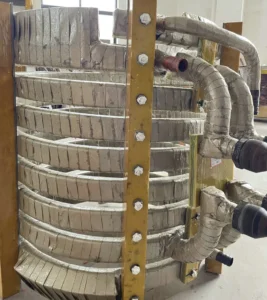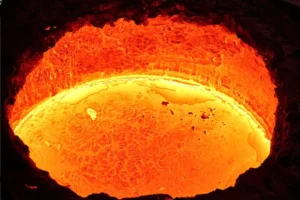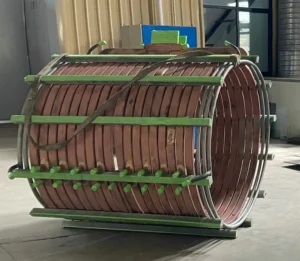
Compared to Electric Arc Furnaces (EAF), the Waste Heat Recovery (WHR) profile of an Induction pugon (KUNG) is unique: its “exhaust gas” temperature is relatively low, but the cooling water carries away a massive amount of heat (approximately 20-30% of total input energy). Samakatuwid, WHR strategies for induction furnaces primarily focus on cooling water thermal energy utilization, followed by flue gas utilization.
Scheme I: Cooling Water for Office/Domestic Heating
This is currently the most mature application for induction furnaces with the shortest payback period.
- Technical Principle:
- Heat Source: The Coil and Power Cabinet of the induction furnace require water cooling. To prevent scaling and oxidation of the copper coil, the outlet water temperature is usually controlled at 40°C – 55°C.
- Utilization Methods:
- Direct Heat Exchange (Low-Temp Heating): Using a Plate Heat Exchanger (PHE) to transfer 45°C-50°C hot water directly to radiant floor heating systems (which have low temperature requirements, typically 35-45°C).
- Heat Pump Elevation (High-Temp Heating): If the office uses traditional radiators (requiring 70-80°C water), a Water-Source Heat Pump is added. The heat pump uses the cooling water as a low-temperature heat source and consumes a small amount of electricity to produce high-temperature water (75°C+).
- Additional Uses: Can be used for staff showers (year-round demand) or absorption chillers in summer (though efficiency is low at 50°C, so not typically recommended).
- Economic Analysis:
- Initial Investment (CAPEX): Low. Main equipment includes plate heat exchangers, pump groups, and water storage tanks. (Cost is medium if a heat pump is added).
- Operating Benefit (OPEX): Very High. Replaces the cost of natural gas boilers or electric heating in winter.
- Return on Investment (ROI):1.5 – 2.5 Years.
- Reference Case: A foundry uses the cooling water from two 5-ton induction furnaces via a water-water heat exchanger to heat a 3,000 sqm office building and dormitory, saving approximately 400,000 RMB in natural gas costs annually.
Scheme II: Waste Heat for Scrap Preheating
Note: Common “scrap preheating” in the industry usually refers to independent gas preheating systems, not WHR from the furnace itself. Using induction furnace waste heat for preheating is considered an “advanced technology.”
- Technical Principle:
- Challenges: IF cooling water (<60°C) is too cool to preheat scrap effectively. IF smoke temperature is also much lower than EAFs, often only 100-150°C after mixing with ambient air in the dust collector hood, lacking sufficient thermal grade.
- Feasible Solution (Flue Gas WHR): The smoke capture system must be retrofitted with a Sealed Furnace Lid o Close Capture Hood to minimize cold air intake, maintaining extracted smoke temperatures above 300°C – 400°C. This high-temp smoke is then directed to a scrap preheating bucket or conveyor.
- Safety Hazards: If scrap contains paint or grease, low-temperature preheating (<500°C) can generate Dioxins or unburned VOCs, requiring subsequent combustion treatment.
- Economic Analysis:
- Initial Investment (CAPEX): High. Involves complex ductwork modification, high-temperature resistant fans, sealed lids, and exhaust treatment systems.
- Operating Benefit (OPEX): Good. For every 100°C increase in scrap temperature, melting electricity consumption drops by about 20-25 kWh/ton.
- Return on Investment (ROI): 3 – 4 Years.
- Recommendation: If the goal is safety (removing moisture to prevent explosions), use mature independent gas preheating. Consider this WHR scheme only for extreme energy saving if the plant already has robust environmental facilities.
Scheme III: Driving ORC Power Generation
For standard induction furnaces, this is usually not economically viable unless specific modifications are made.
- Technical Principle:
- Heat Source Bottleneck: Organic Rankine Cycle (ORC) generation typically requires a heat source >90°C for decent economic efficiency (generation efficiency ~8-10%). Gayunpaman, if standard IF cooling water exceeds 60°C, copper coil life drops drastically, and scaling risks increase.
- Solution (Pressurized High-Temp Cooling): The furnace cooling system must be upgraded to a Pressurized High-Temperature Water System (outlet temp raised to 95-120°C). This requires special high-temp coil designs and strict water quality management (deionized water).
- Dual SourceCoupling: Another approach combines “flue gas waste heat” with “cooling water waste heat”—using smoke to heat the working fluid to a higher temperature and cooling water for preheating—but this system is extremely complex.
- Economic Analysis:
- Initial Investment (CAPEX): Extremely High. ORC generator sets are expensive (approx. 8,000-12,000 RMB/kW), plus the cost of retrofitting the furnace cooling system.
- Operating Benefit (OPEX): Average. Net generation efficiency for low-temp ORC is only 5%-7%.
- Return on Investment (ROI): > 6 – 8 Years.
- Konklusyon: Unless it is a mega-scale continuous melting workshop (hal., single furnace capacity >20 tons, multiple furnaces running), ORC on induction furnaces is often not cost-effective.
Comprehensive Comparison & Decision Matrix
| Dimension | Scheme I: Office Heating/Showers | Scheme II: Scrap Preheating (WHR Ver.) | Scheme III: ORC Power Generation |
| Heat Source | Cooling Water (45-55°C) | High-Temp Flue Gas (>300°C) | Pressurized Water (>95°C) |
| Tech Maturity | ★★★★★ (Very Mature) | ★★★ (Complex) | ★★ (Requires Customization) |
| Initial Investment | Low | High | Extremely High |
| ROI Period | 1.5 – 2.5 Years | 3 – 4 Years | > 6 Years |
| Key Advantage | Replaces essential costs; immediate effect; simple maintenance | Reduces melting power consumption; increases yield | Produces high-value electricity; enhances corporate image |
| Best Scenario | Cold regions; Factories with dorms/showers | Large-scale continuous foundries | Mega-smelters; Areas with very high electricity rates |
Recommended Next Steps
If you are considering Induction Furnace WHR for the first time, a step-by-step approach is recommended:
Step 1 (Essential): Implement Cooling Water Heat Exchange Retrofit. Install a plate heat exchanger in parallel with the existing cooling tower.
Action: Solve staff shower hot water needs first (saving electricity/gas year-round). If located in a cold region, integrate into the heating grid in winter.
Step 2 (Optional): Evaluate Scrap Preheating.
Criteria: Does your furnace have a sealed smoke hood? Is the smoke outlet temperature consistently above 200°C? If yes, consider flue gas preheating. If not, it is better to purchase an independent natural gas preheating bucket to improve safety and efficiency rather than forcing a WHR solution.