In induction melting operations, skull formation (the solidification of metal on the refractory surface) in the tapping spout is a significant challenge. It leads to restricted metal flow, reduced yield, potential contamination, and damage to the lining during cleaning.
Below are five core strategies to resolve skulling, along with an analysis of the underlying thermal mechanics.
I. Analysis of the Causes of Rapid Temperature Drop in the Tapping Spout
To solve skulling, we must first address the three primary modes of heat loss:
- Conduction Heat Dissipation: Heat from the molten metal is rapidly conducted through the refractory materials to the metal shell of the vessel.
- Convection Heat Dissipation: The exposed surface of the tapping spout comes into direct contact with the air, generating intense atmospheric convection.
- Radiation Heat Dissipation: The high-temperature molten metal releases heat into the surrounding environment in the form of electromagnetic waves (radiative heat loss increases with the fourth power of the temperature).
II. 5 Practical Solutions to Eliminate Skulling
1. Optimize Refractory and Composite Insulation Structures
Increasing refractory thickness alone is often insufficient. A “Working Lining + Insulation Layer” composite design is more effective:
- High-Conductivity Working Lining: Use a dense, slag-resistant material (hal., Alumina-Carbon or Corundum-based ramming mass) for the contact layer.
- Low-Conductivity Backup: Insert microporous insulation boards o ceramic fiber blankets between the working lining and the outer shell.
- Effect: This structure significantly increases thermal resistance, slowing heat transfer to the shell and maintaining a high “hot face” temperature.
2. Standardization of Preheating (Spout Drying)
Skulls most frequently form during the first tap because the spout has not reached thermal equilibrium.
- Full-Length Preheating: Use long-flame gas burners or infrared heaters to ensure uniform heating from the furnace mouth to the end of the spout.
- Temperature Targets: For cast iron or steel, the refractory surface should ideally reach 800°C to 1000°C before tapping.
- Thermal Covers: Keep the spout covered with insulated lids during preheating and idle times to trap radiant heat.
3. Active Induction-Heated Tapping Spouts
This is the most robust solution for long launders or high-precision casting where temperature loss is unacceptable.
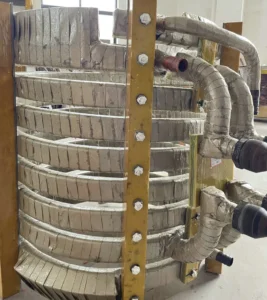
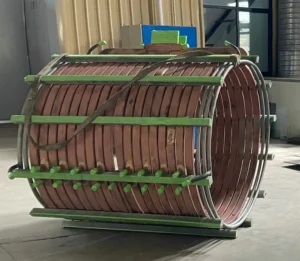
- Principle: Small induction coils (usually medium frequency) are embedded behind the refractory lining.
- Advantage: The system provides “active compensation” by directly heating the molten metal or specialized graphite lining blocks via electromagnetic induction.
- Use Case: Ideal for continuous tapping operations or processes requiring extremely tight temperature tolerances (±5°C).
4. Optimization of Geometry and Enclosure
- Minimize Surface-to-Volume Ratio: Keep the spout as short as possible. Design for a “deep and narrow” profile rather than “shallow and wide” to reduce the exposed surface area of the melt.
- Sealed Covers: Use insulated covers or introduce an inert gas shroud during tapping. This suppresses convective heat loss and prevents the formation of thick oxide skins, which act as nucleation points for skulls.
5. Adjustment of Superheat and Slag Chemistry
- Control Superheat: Accurately calculate the temperature drop from the furnace to the ladle. If the spout is long, increase the furnace tapping temperature (typically by 20°C to 50°C) to compensate.
- Slag Modification: High-viscosity slag adheres easily to spout walls. Use fluxing agents (such as fluorspar or specialized slag conditioners) to improve fluidity, ensuring that residual metal and slag slide off cleanly without leaving a “seed” for skull growth.
III. Technical Summary
| Method | Core Logic | Investment Cost | Maintenance Effort |
| Insulation Materials | Reduces conduction | Low | Low |
| Standardized Preheating | Establishes thermal equilibrium | Medium | Medium |
| Induction Heating | Active thermal compensation | High | High |
| Insulated Covers | Inhibits radiation & convection | Low | Very Low |
| Metallurgical Control | Improves fluidity/flow | Low | Low |