Content Focus: Exploring how to build a closed-loop quality control system. Once the spectrometer analyzes the composition, the data is automatically transmitted to the batching system. Based on the deviation between the target specification and the current furnace composition, the system automatically calculates and issues instructions for the next batch of alloy additions.
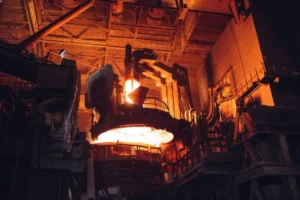
In the modern precision casting and metallurgical industry, the efficiency and quality of the melt shop often depend on the synergistic capability of three core pieces of equipment: ang Induction pugon (The Melting Vessel), ang Furnace-side Optical Emission Spectrometer (The Eye of Quality), and the Automated Batching System (The Control Brain).
In traditional melting workflows, these three entities often exist as isolated islands: manual sampling, manual reading, and manual calculation of additives. This is not only inefficient but also highly prone to human errors resulting in “composition overshoot” or non-compliance.
How to break down these barriers and build a data-driven, closed-loop quality control system?
1. Core Logic, The Closed-Loop Workflow
To realize the integration of “The Iron Triangle,” the core lies in the automatic flow of data at intelligent decision-making. The entire closed-loop process is as follows:
Step 1: Rapid Furnace-side Analysis (The Sensor)
- When the molten metal in the induction furnace reaches the predetermined temperature, the operator takes a sample coupon (button) and sends it to the Optical Emission Spectrometer (OES).
- The OES completes a multi-element analysis (C, Si, Mn, P, S, Cr, Ni, atbp.) within seconds.
Step 2: Seamless Data Transmission (The Data Link)
- Key Point: Eliminate manual transcription or radio reporting.
- Via an industrial Ethernet (TCP/IP) or serial communication (RS232/485) interface, the OES directly pushes the analysis results (in XML/CSV/JSON format) to the Central Control Unit of the Batching System.
Step 3: Intelligent Deviation Calculation (The Brain)
- Upon receiving the real-time composition data, the batching system immediately compares it against the current weight of molten iron in the furnace and the preset target grade.
- Algorithm Logic:
- Required Addition =(Target % – Current %) * Total Molten Weight / Alloy Recovery Rate %
- The system automatically corrects for burn loss (recovery rate) and calculates the optimal list of additives based on the grade of alloys currently in stock.
Step 4: Automatic Execution & Feedback (The Action)
- Instructions are issued to the automatic feeding mechanism (vibratory feeder or belt conveyor).
- The system precisely weighs the required ferrosilicon, ferromanganese, recarburizers, atbp., and automatically feeds them into the induction furnace.
- Loop Closed: Sampling is performed again for confirmation. The system displays “Permission to Tap” only when the composition hits the target window perfectly.
2. In-Depth System Architecture
To achieve the closed loop described above, the roles of each component undergo a fundamental shift:
A. Furnace-side Spectrometer: Mula sa “Recorder” sa “Trigger”
In an integrated system, the spectrometer is not just a testing device; it is the trigger point for the workflow.
- Function Upgrade: Must possess open data interfaces (such as OPC UA protocol) to support remote triggering.
- Exception Alarms: If harmful elements (hal., P, S) are detected at levels that cannot be corrected via additives, the system immediately locks the batching process to prevent erroneous operations.
B. Automated Batching System: Mula sa “Calculator” sa “Decision Hub”
This is the brain of the “Iron Triangle.” It calculates not only “how much is missing” but also “the most cost-effective way to add it.”
- LCC (Least Cost Charge) Optimization: If multiple alloys can satisfy the adjustment (hal., using pure nickel vs. nickel plate), the system automatically selects the lowest-cost formulation based on current raw material market prices.
- Dynamic Adjustment: The system maintains a burn-loss database for different temperatures and materials, which self-learns and corrects itself as production proceeds.
C. Induction pugon: Mula sa “Black Box” sa “Transparent Container”
By integrating Load Cells, the induction furnace transmits the molten metal weight to the batching system in real-time.
- Importance: Without accurate weight data, composition adjustment calculations are futile. Real-time weighing ensures the precision of additive quantities.
3. Core Value of Integration
A. Eliminating “Composition Overshoot“
Manual calculations often lead to the excessive addition of expensive alloys (such as Molybdenum, Nickel, Tanso) due to over-cautiousness or lack of experience. An automated closed-loop system can control the composition within a very narrow range above the lower limit, saving significant alloy costs annually
B. Shortening Tap-to-Tap Time
Data transmission and calculations are completed in milliseconds. This eliminates the time spent on manual movement, calculation, and verification. Saving 3-5 minutes per heat means an extra batch of molten iron per day for continuous production foundries.
C. Full Traceability
Every sampling data point, every additive action, and the final tapping composition are automatically timestamped and stored in the database. This is critical for clients in automotive and aerospace sectors with strict quality traceability requirements.
4. Implementation Suggestions & Challenges
When building this “Iron Triangle,” attention must be paid to the following technical details:
- Standardization of Protocols: Ensure that both the OES vendor and the Batching System vendor support the same communication protocols (OPC UA or Modbus TCP are recommended).
- Environmental Interference: The furnace environment has severe electromagnetic interference. Data transmission cables must utilize fiber optics o high-shielding twisted pairs.
- Data Accuracy: The system’s accuracy depends on the initial setting of the “Alloy Recovery Rate.” In the early stages of system deployment, operators must continuously verify and calibrate this parameter.
Summary
The integration of the Induction Furnace, Spectrometer, and Batching System essentially digitizes metallurgical principles. It no longer relies on the personal experience of the furnace operator but on data flows and algorithms. This is not only a closed loop for quality control but also the first step for a foundry moving towards a Digital Factory (Foundry 4.0).