Vacuum Induction Pagtunaw (VIM) & Vacuum Induction Gas Atomization (VIGA): Core Process Analysis for High-End Metal Powder Preparation (hal., Additive Manufacturing)
In modern high-end manufacturing sectors—such as aerospace, medical implants, automotive lightweighting, and metal additive manufacturing/3D printing—high-performance metal powders serve as the essential “raw flour” determining the final quality of components. Among various technologies, the combined Vacuum Induction Pagtunaw (VIM) at Vacuum Induction Gas Atomization (VIGA) process is universally recognized as the “gold standard” for producing high-performance, high-purity, and highly spherical metal powders.
1. Process Overview: Why Choose VIM + VIGA Combination?
High-end metal powders (such as titanium alloys, superalloys, high-strength steels, and cobalt-chromium alloys) are extremely sensitive to impurities like oxygen, nitrogen, and hydrogen. Traditional powder production methods often result in high oxygen content and irregular particle shapes, leading to pores, inclusions, and reduced fatigue life in sintered or printed parts.
Key Advantages of the Combined VIM + VIGA Process:
- Fully Enclosed, Contamination-Free Environment: The entire process—from melting to atomization—takes place under high vacuum or high-purity inert gas protection, eliminating oxidation at the source.
- Precise Composition Control: The intrinsic electromagnetic stirring effect of induction heating ensures exceptional chemical homogeneity.
- Superior Powder Performance: Produces powders with high sphericity, excellent flowability, high apparent density, and minimal hollow/satellite particles—perfectly tailored for additive manufacturing processes like Selective Laser Melting (SLM) and Electron Beam Melting (EBM).
2. Core Step I: Vacuum Induction Pagtunaw (VIM)
VIM serves as the “first workshop” of the production process, primarily responsible for melting high-purity master alloys and fine-tuning their chemical composition.
Working Principle
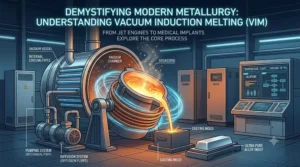
High-purity raw metals (or recycled scrap) are loaded into a refractory crucible inside a vacuum induction furnace. Alternating magnetic fields generated by medium- or high-frequency induction coils induce eddy currents within the metal charge, rapidly melting it via Joule heating.
Core Technical Advantages
- Efficient Degassing and Refining: Under high vacuum (or controlled micro-pressure), dissolved gases (such as O_2, H_2, N_2) and volatile low-boiling-point impurities effectively evaporate and escape through the gas-liquid interface.
- Electromagnetic Stirring: The natural electromagnetic stirring effect ensures uniform temperature distribution and precise alloy composition throughout the melt.
- Precise Composition Control: Reactive and easily oxidizable elements (such as titanium, aluminyo, and zirconium) can be added under vacuum or inert atmosphere without risk of burn-off.
3. Core Step II: Vacuum Induction Gas Atomization (VIGA)
VIGA is the critical shaping stage where the refined high-temperature melt from VIM is transformed into micron-sized powder.
Working Principle
- Tundish Guidance & Thermal Retention: The refined alloy melt flows continuously from the VIM furnace into a thermally controlled tundish and ceramic nozzle, forming a stable vertical liquid stream.
- High-Speed Gas Disintegration: As the liquid stream passes through a specialized nozzle at the top of the atomization tower, it is impacted by high-pressure, high-velocity inert gas jets (typically high-purity argon or nitrogen).
- Rapid Solidification: The melt stream is instantly sheared, atomized, and fragmented into countless micro-droplets. As these droplets fall through the atomization tower, surface tension shapes them into spheres before they rapidly cool and solidify in the inert gas atmosphere.
Key Process Parameters & Influence
- Atomization Pressure & Gas Velocity: Directly determines kinetic energy. Higher pressures and gas velocities yield a finer median particle size ( D_50 ).
- Gas-to-Metal Ratio (GMR): Affects the cooling rate and fine powder yield.
- Nozzle Material & Design: Prevents premature solidification (“skulling” o “mushrooming”) at the exit tip while maintaining stable liquid stream diameter.
4. Post-Processing & Quality Control
Atomized powders cannot be used directly in high-end applications until they pass through rigorous post-processing and quality assurance steps:
- Cyclone Separation & Sieving: Powders are separated from the carrier gas via cyclone separators, followed by precision ultrasonic sieving or air classification to remove oversized particles and satellites. This isolates specific particle size distributions (PSD) required for additive manufacturing (hal., 15-53μm or 53-150 μm).
- Vacuum Degassing & Drying: Removes surface-adsorbed moisture and residual gases from the powder.
- Critical Quality Testing:
- Morphology & Particle Size: Evaluated via Scanning Electron Microscopy (SEM) and Laser Diffraction Particle Size Analyzers for sphericity and PSD.
- Chemical Analysis: Measures $O, N, H, C$ contents and major alloying element proportions.
- Physical Properties: Measures apparent density and tap density to assess powder flowability (Hall/Carney flow rate).
5. Application Fields & Future Trends
High-end metal powders produced via the VIM-VIGA process are widely utilized in:
- Aerospace Engines: Superalloy turbine disks and combustion chamber components.
- Aerospace Structural Parts: Lightweight titanium alloy (hal., Ti-6Al-4V) components with complex conformal cooling channels.
- Biomedical Engineering: Porous bone implants and dental cobalt-chromium alloys.
- Tooling & Mold Making: Injection molds featuring conformal cooling channels.
As additive manufacturing technology continues to advance, the demand for ultrafine powders ( < 20μm ), ultra-low oxygen content, and higher yields is driving VIM-VIGA equipment toward greater automation and intelligent process control (hal., real-time monitoring of melt temperature, pressure, and particle size distribution).