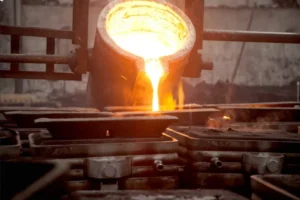
In the high-temperature world of induction melting and heating, the cooling system is the “Lifeline” of the equipment. Induction coils and power supply systems have extremely strict water quality requirements; any scaling or blockage can lead to reduced efficiency at best, or a catastrophic coil meltdown at worst.
Here is a detailed technical comparison between Closed Circuit Cooling Towers (CCT) и Evaporative Condensers (EC) specifically for induction furnace applications.
Основное сравнение: CCT vs. EC
| Измерение | Closed Circuit Cooling Tower (CCT) | Evaporative Condenser (EC) |
| Первоначальные инвестиции | Умеренный. Standardized structure with flexible material options. | Высокий. Usually utilizes stainless steel or heavy galvanized coils; higher overall cost. |
| Water Saving | Отличный. The internal loop is fully sealed with nearly zero loss. | Хороший. Однако, high heat flux leads to slightly higher spray water evaporation. |
| Scaling Resistance | Strong. Stable internal water; external spray water is easy to treat. | Challenging. Higher tube wall temperatures make external scaling more likely. |
| Maintenance Cost | Ниже. Wear parts are standard fans and pumps. | Умеренный. Dense tube arrays make manual descaling extremely difficult. |
| Environmental Adaptability | Универсальный. Supports antifreeze; superior in extreme cold climates. | Niche Leader. Extremely efficient in dry, high-ambient temperature regions. |
Technical Deep Dive
Heat Exchange Mechanism: Sensible vs. Latent Heat
While both use evaporative cooling, their thermodynamic focus differs in induction applications:
- Closed Circuit Cooling Tower (CCT): Primarily relies on sensible heat exchange. The internal soft water carries heat from the furnace and transfers it through the tube wall to the external spray water film.
- Induction Benefit: Provides a very stable “temperature rise curve,” which is crucial for protecting sensitive electronics like IGBT power modules.
- Evaporative Condenser (EC): Focuses on скрытое тепло exchange (the energy absorbed during phase change).
- Induction Benefit: During extreme summer peaks (ambient > 38℃), the EC can leverage high evaporation rates to force return water temperatures below the typical furnace alarm threshold (45 – 50℃).
Scaling: The “Arch-Nemesis” of Induction Coils
Failure in these systems is 90% due to external tube scaling, which creates a thermal barrier, causing the internal loop to overheat.
- CCT (Crossflow/Counterflow): Designed with high spray water flow rates to “flush” the tube walls, preventing dry spots where minerals deposit.
- Обслуживание Преимущество: Filling and coils are often separated, allowing for easier cleaning of calcium/magnesium deposits without dismantling the whole system.
- EC (Serpentine Coil Design): Coils are packed very tightly to save space. High heat flux can cause “flash evaporation” on the tube surface, leading to hard scale.
- Обслуживание Недостаток: Once the center of the coil bundle scales up, manual cleaning is nearly impossible, often requiring aggressive chemical acid washing.
Материалы & Longevity: Copper vs. Сталь
Induction furnaces require low electrical conductivity (обычно < 50 μS/cm) in the cooling water.
- CCT Choice: Обычно T2 Purple Copper. It offers superior thermal conductivity and excellent corrosion resistance against treated internal water. Life expectancy: 10–15 years.
- EC Choice: Обычно 304/316 Нержавеющая сталь или Heavy Galvanized Steel. While structurally strong, stainless steel can be susceptible to pitting if the spray water chemistry isn’t perfectly managed. Life expectancy: 8–12 years.
Матрица решений: Which should you choose?
| Scenario | Recommended Solution | Рассуждение |
| Large Melting Furnaces (> 5 тонны) | CCT | Prioritizes system stability and long-term reliability. |
| High/Ultra-high Frequency Equipment | CCT | Extremely sensitive to temp fluctuations (requires control within ± 2℃). |
| Space-Constrained Retrofits | EC | More compact footprint and higher integration. |
| Hard Water Regions | CCT | You must have a maintainable structure, or the unit will fail within 2 годы. |
| Energy-Efficiency Benchmarking | EC | Lower fan horsepower requirements per kW of cooling. |
Final Recommendation
- Choose the Closed Circuit Cooling Tower if you want the “safe bet”—it is the industry standard for a reason: it’s robust, easier to fix, and protects the furnace coil over the long haul.
- Choose the Evaporative Condenser if you are an “optimizer” with limited floor space and a top-tier water treatment team on-site to manage scaling risks.
Expert Tip: Never skimp on the spray pump. If the spray system fails, a closed system’s cooling capacity drops by over 80% instantly, and your induction furnace will be “seeing red” (literally) in minutes.