High-Frequency vs. Medium-Frequency vs. Power-Frequency Induction Furnaces: Core Differences and Application Scenarios
The core difference among these three types of induction furnaces lies in their operating frequency. The difference in frequency directly determines the depth of the “Skin Effect” of the current inside the metal and the magnitude of the electromagnetic stirring force, leading to highly significant differences in their melting characteristics and application scenarios.
Here is a detailed analysis of their core differences and application scenarios:
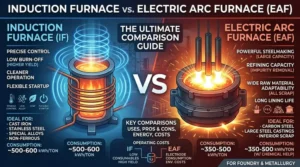
Core Differences Comparison Matrix
| Feature | Power-Frequency | Medium-Frequency | High-Frequency |
| Operating Frequency | 50Hz or 60Hz (Mains frequency) | 150Hz – 10kHz | 10kHz – 300kHz and above |
| Current Penetration Depth | Deep | Medium | Extremely shallow (surface only) |
| Electromagnetic Stirring Force | Extremely strong | Moderate | Weak |
| Starting Method | Requires residual molten metal or starting blocks (Cannot cold start) | Direct cold furnace starting possible | Direct cold furnace starting possible |
| Equipment Size | Bulky | Compact | Small |
1. Power-Frequency Induction Furnace: The Large-Tonnage “Holding Behemoth”
Power-frequency induction furnaces directly utilize the 50Hz or 60Hz alternating current from the industrial power grid without the need for frequency conversion devices.
- Core Advantages: The intense electromagnetic stirring effect ensures extremely uniform metal composition and temperature; due to the absence of frequency conversion losses, the structure is relatively simple and durable.
- Pangunahing Limitations: Cannot be started directly from a cold furnace. After each shutdown, a portion of the molten iron must be retained in the furnace, or dedicated starting blocks must be added for the next startup; slower heating rate; lower power factor.
- Application Scenarios: Suitable for large foundries engaged in continuous production. Primarily used for large-tonnage melting of cast iron and non-ferrous metals, as well as serving as a “holding furnace” o “conditioning furnace” in duplex melting processes (hal., cupola-induction furnace duplexing).
2. Medium-Frequency Induction Furnace: The “All-Around Workhorse” of Modern Foundries
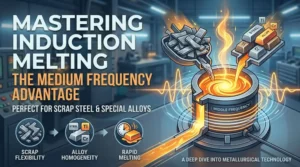
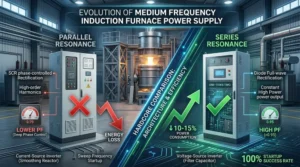
Medium-frequency induction furnaces utilize frequency conversion technologies, such as SCR (thyristors) or IGBTs, to convert power-frequency AC into medium-frequency AC. It is currently the most widely used equipment in the industrial casting and metallurgy sectors.
- Core Advantages: Perfectly balances heating efficiency and stirring effects. Capable of 100% direct cold furnace starting, making it highly convenient to empty the furnace hearth or switch steel grades; high power density, fast heating speed, and high thermal efficiency; flexible operation.
- Pangunahing Limitations: Requires the additional configuration of a medium-frequency power supply cabinet, making the initial equipment investment slightly higher than traditional setups.
- Application Scenarios: Covers nearly all conventional casting requirements. Widely utilized for the melting and holding of carbon steel, alloy steel, special steels, and various non-ferrous metals (copper, aluminyo, zinc).
3. High-Frequency Induction Furnace: The “Scalpel” for Precision and Surfaces
The extremely high frequency of high-frequency induction furnaces causes the current to concentrate almost entirely on the outermost layer of the metal (intense Skin Effect).
- Core Advantages: Extremely rapid heating speed (can complete surface heating within seconds); minimal impact on the internal structure of the workpiece, resulting in highly limited oxidation and decarburization.
- Pangunahing Limitations: The current penetration depth is too shallow, and the electromagnetic stirring force is extremely weak, making it incapable of overall melting for large volumes of metal.
- Application Scenarios: Mainly applied in the surface quenching of metal parts, localized heat treatment, and high-frequency welding (hal., high-frequency welded pipes). For melting purposes, it is strictly limited to the preparation of small sample quantities in laboratories, or the micro-refining of precious metals such as gold, pilak na pilak, and platinum.
Summary Recommendations
- If you need to continuously melt the same type of metal in large batches, or if you require large-capacity holding equipment, ang power-frequency induction furnace remains the traditional and economical choice.
- If you operate a modern foundry managing multi-variety, small-to-medium batches, frequently switch alloy types, and demand highly efficient and flexible cold starting, ang medium-frequency induction furnace is the undisputed optimal choice.
- If your focus is on metal surface heat treatment, or the micro-refining of precious metals and laboratory testing, you must utilize a high-frequency induction furnace.