Mengungkap Prinsip Kerja Tungku Induksi: Bagaimana Medan Magnet Melelehkan Logam Tanpa Kontak?
Rahasia inti bagaimana tungku induksi dapat melebur berton-ton logam menjadi baja cair tanpa kontak dengan sumber panas terletak pada kombinasi sempurna antara induksi elektromagnetik Dan Pemanasan Joule. Ini bukan konduksi panas luar, melainkan mengubah logam itu sendiri menjadi masif “elemen pemanas.”
Berikut adalah rincian langkah-langkah inti bagaimana medan magnet mencapai peleburan logam tanpa kontak.
Melangkah 1: Lahirnya Medan Magnet Bolak-balik
Struktur inti tungku induksi adalah kumparan induksi yang terbuat dari pipa tembaga (biasanya dililitkan pada wadah yang terbuat dari bahan tahan api). Ketika arus bolak-balik kuat (AC) melewati kumparan ini, sesuai dengan prinsip elektromagnetisme, medan magnet bolak-balik cepat dengan frekuensi yang sama dihasilkan di dalam dan di sekitar kumparan.
- Pada tahap ini, sistem ini hanya menciptakan lingkungan medan magnet berintensitas tinggi dan tidak menghasilkan panas langsung untuk peleburan.
Melangkah 2: Generasi Arus Eddy
Ketika muatan logam yang akan dicairkan ditempatkan dalam wadah (yaitu, dalam medan magnet bolak-balik), sebuah fenomena ajaib terjadi. Menurut Hukum induksi Faraday, ketika fluks magnet melalui rangkaian tertutup berubah, suatu gaya gerak listrik (EMF) diinduksi.
Dalam tungku induksi, muatan logam itu sendiri merupakan konduktor listrik yang baik. Medan magnet bolak-balik menembus muatan logam, menginduksi loop tertutup dari arus induksi di dalam logam. Arus ini dikenal sebagai Arus Eddy.
Melangkah 3: “Pemanasan Sendiri” Di dalam Logam (Pemanasan Joule)
Inilah kekuatan pendorong sebenarnya di balik peleburan logam. Meskipun logam merupakan konduktor, masih memiliki hambatan listrik tertentu (R). Ketika arus eddy sangat kuat (SAYA) mengalir melalui logam, menurut hukum Joule, usaha yang dilakukan oleh arus melawan hambatan melepaskan sejumlah besar panas.
- Inti dari peleburan tanpa kontak: Panas dihasilkan seluruhnya di lokasi dari di dalam logam, daripada dilakukan dari luar ke dalam seperti tungku api tradisional. Metode pemanasan ini sangat cepat, sangat efisien, dan memiliki kehilangan panas minimal, memungkinkan logam mencapai titik lelehnya dalam waktu singkat.
Melangkah 4: Pengadukan Elektromagnetik — Keuntungan Tersembunyi dalam Metalurgi
Selain menghasilkan panas, pengoperasian tungku induksi disertai dengan fenomena fisik yang penting bagi teknik metalurgi: gaya elektromagnetik (gaya Lorentz).
Interaksi antara medan magnet dan arus eddy pada logam cair menghasilkan gaya dorong elektromagnetik yang kuat pada logam cair.. Gaya ini menyebabkan baja cair berputar dan diaduk dengan keras ke atas dan ke bawah di dalam wadah.
- Fungsi: Hal ini tidak hanya memastikan suhu yang benar-benar seragam di dalam kolam cair tetapi juga memungkinkan elemen paduan tambahan terdistribusi dengan cepat dan merata. Serentak, ini membantu inklusi non-logam mengapung ke permukaan untuk membentuk terak, sangat meningkatkan kemurnian metalurgi pengecoran.
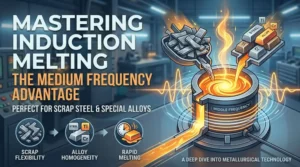
Pertimbangan Frekuensi untuk Peralatan Inti: Keseimbangan Emas Tungku Induksi Frekuensi Menengah
Dalam produksi pengecoran aktual dan teknik metalurgi, pilihan frekuensi catu daya menentukan karakteristik tungku induksi.
Ketika frekuensi saat ini berada di rentang frekuensi menengah (khas 150 Hz ke 8000 Hz), peralatan mencapai keseimbangan teknik yang sangat baik:
- Kedalaman Penetrasi Sedang: Itu “efek kulit” arusnya tepat, memastikan konversi energi listrik menjadi panas yang efisien sambil menembus jauh ke dalam balok logam. Ini sangat cocok untuk peleburan cepat potongan baja bekas berukuran besar dan muatan berat.
- Kekuatan Pengadukan Optimal: Frekuensi yang lebih rendah menghasilkan gaya pengadukan elektromagnetik yang lebih kuat. Kekuatan pengadukan frekuensi menengah tungku induksi cukup untuk mencapai keseragaman komposisi dan suhu yang sempurna, tanpa menyebabkan oksidasi parah pada baja cair atau erosi berlebihan pada lapisan tungku akibat pengadukan berlebihan.
Keseimbangan sempurna antara efisiensi peleburan dan kontrol kualitas metalurgi menjadikan teknologi frekuensi menengah sebagai andalan mutlak dalam pengecoran modern dan proses peleburan baja khusus..