In modern casting processes, especially when using a medium-frequency induction furnace for melting, precise control of temperature and composition for gray cast iron and ductile iron is the core key to determining the mechanical properties of castings and reducing scrap rates. Because medium-frequency induction furnaces feature rapid heating and strong electromagnetic stirring, their control techniques differ from those of traditional cupolas.
Here are the precise control points for temperature and composition during the induction furnace melting process for these two materials:
I. Precise Control Techniques for Gray Cast Iron
The performance of gray cast iron highly depends on the morphology of graphite and the matrix structure, with the core lying in the control of Carbon Equivalent (CE) and inoculation treatment.
1. Composition Control Points
- Carbon Equivalent (CE) and Carbon-Silicon Ratio: Strictly control the C and Si content. Typically, ang “high carbon, low silicon” o “low carbon, high silicon” principle is adopted. Gayunpaman, in induction furnaces, to reduce graphitization expansion and shrinkage tendencies, a strategy of appropriately lowering the carbon equivalent and increasing the ferrosilicon inoculation ratio is recommended.
- Manganese and Sulfur Balance: A certain amount of sulfur (usually between 0.06% – 0.12%) must be maintained in gray cast iron to form MnS, which serves as the core for graphite precipitation. Medium-frequency furnace melting usually “desulfurizes” the molten iron. Samakatuwid, if a scrap steel plus recarburizer process is used, artificial sulfur addition (such as adding iron sulfide) is often required.
- Alloy Element Fine-Tuning: Utilize a rapid spectrometer in front of the furnace to take samples for analysis 10 minutes before tapping, and fine-tune alloy elements such as Cu, Cr, and Mo to strengthen the pearlitic matrix.
2. Temperature Control Points
- Superheating Temperature: When melting gray cast iron in an induction furnace, proper superheating can refine graphite. It is recommended to superheat the molten iron to 1500°C – 1520°C and hold it for 5 – 10 minutes. This helps eliminate the graphite heredity from the raw materials.
- Tapping and Pouring Temperature: The tapping temperature should be controlled between 1450°C – 1480°C. The pouring temperature is usually between 1380°C – 1420°C. If the temperature is too high, it will cause sand burn and porosity; if too low, it easily leads to cold shuts and chilled edges (white iron).
II. Precise Control Techniques for Ductile Iron
Ductile iron has extremely high requirements for the purity of the molten iron and the tapping temperature, as the subsequent nodularization (spheroidization) reaction causes significant heat and composition loss.
1. Composition Control Points
- Strictly Control S and P in Base Iron: This is the ironclad rule for melting ductile iron. The sulfur content must be extremely low (< 0.03%); otherwise, it will consume a large amount of nodularizer (magnesium) and produce excessive magnesium sulfide dross. Low-sulfur pig iron, high-quality scrap steel, and low-sulfur recarburizers must be selected.
- Selection of Carbon Equivalent: The carbon equivalent of ductile iron is usually higher than that of gray cast iron (CE is selected between 4.3% – 4.7%) to utilize graphitization expansion for self-feeding and reduce shrinkage defects.
- Absorption Rate of Nodularization and Inoculation: Magnesium has a low boiling point (1107°C) and vaporizes easily in high-temperature molten iron. It is necessary to accurately calculate the weight of the base iron, use the sandwich method (cover method) or in-mold nodularization, and perform multi-step inoculation (tapping inoculation, transfer ladle inoculation, stream inoculation) to prevent inoculation fade.
2. Temperature Control Points
- Increase Tapping Temperature: Because the nodularization treatment (adding magnesium-silicon alloy) and multiple inoculations will cause a sudden drop in the temperature of the molten iron (usually by 50°C – 80°C), the tapping temperature of the medium-frequency furnace must be higher than that of gray cast iron, usually set between 1480°C – 1530°C.
- Control Holding Time: High-temperature molten ductile iron should not be held in the furnace for a long time; otherwise, it will cause carbon oxidation and silicon reduction, leading to composition drift. A “fast melting and fast tapping” approach should be achieved.
III. Core Operating Specifications for Medium-Frequency Induction Furnace Melting
To translate the above theories into precise control in actual production, the following operations must be standardized:
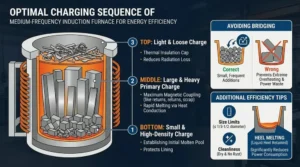
- Charge Management (Prerequisite): Implement strict classification and weighing of the furnace charge before charging. Scrap steel must be de-rusted and degreased to prevent the introduction of excessive hydrogen and oxygen.
- Skillful Use of Electromagnetic Stirring: Recarburizers should be added early in the melting process along with the bottom charge to utilize the electromagnetic stirring eddy currents in the middle and late stages of the induction furnace, improving carbon absorption and avoiding poor absorption caused by late carbon addition.
- Combined Application of Thermal Analyzers: Combining a direct-reading spectrometer in front of the furnace (measuring absolute composition) and a thermal analysis sample cup (measuring the cooling curve, undercooling degree, and chilling tendency of the molten iron) can most intuitively predict the inoculation effect and allow for rapid intervention before tapping.