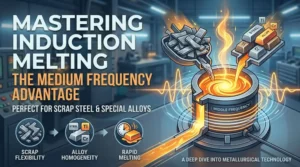
01 What is VIM? Breaking Down the Physical Principles
Simply put, VIM is a modern metallurgical process that uses electromagnetic induction to heat, melt, and refine metal without contact in a high-vacuum environment. Its operation relies on two core physical effects:
- Induction Eddy Current Heating: When an alternating current (AC) flows through a copper coil surrounding the crucible, it generates a powerful alternating magnetic field inside. This magnetic field penetrates the metallic charge, inducing closed loops of eddy currents within the metal. Utilizing the intrinsic electrical resistance of the metal, electrical energy is efficiently converted into thermal energy, rapidly melting the metal from within.
- Electromagnetic Stirring Effect: The interaction between the alternating magnetic field and the induced currents in the molten metal produces Lorentz forces, causing the liquid metal to churn spontaneously. This natural “mechanical-free stirring” ensures composition uniformity down to the micron level and continuously brings dissolved gases and inclusions from the depths to the surface.
02 Why Must Steel Be Smelted in a “Vacuum”?
Conventional induction furnaces operate in open air. However, for high-end alloys, oxygen, nitrogen, and water vapor in the atmosphere are deadly sources of defects. The core value of VIM lies in the extreme purification capabilities enabled by the vacuum environment:
- 🛡️ Preventing Oxidation of Reactive Elements: Elements such as Titanium (Ti), Aluminum (Al), Niobium (Nb), and Zirconium (Zr) have an extremely high affinity for oxygen. Smelting in air rapidly forms oxide inclusions, making the material brittle. In VIM’s high-vacuum environment, these reactive elements can be added stably according to precise proportions.
- 💨 Deep Degassing: According to gas solubility laws (e.g., Sieverts’ Law), a low-pressure environment drives dissolved harmful gases like Hydrogen (H), Nitrogen (N), and Oxygen (O) to escape in large quantities from the melt. This drastically reduces micro-porosity in the cast ingot and avoids catastrophic defects like hydrogen embrittlement.
- 🔥 Evaporating Harmful Trace Elements: Low-melting-point impurity elements such as Lead (Pb), Bismuth (Bi), Arsenic (As), and Tin (Sn) have high vapor pressures at elevated temperatures in a vacuum. They evaporate directly into the gas phase, achieving “deep purification” of the liquid metal.
Metallurgical Insight: Vacuum Carbon Deoxidation (VCD)
Under vacuum conditions, the partial pressure of CO gas generated by the reaction between carbon and oxygen is significantly reduced, driving the reaction [C] + [O] → CO(g)↑ strongly to the right. This allows metallurgical engineers to produce ultra-low carbon specialty alloys without burning off expensive alloying elements like Chromium (Cr).
03 Core Equipment Architecture: Dissecting a VIM Furnace
An industrial-grade VIM system is a highly integrated combination of high vacuum, high-power electrical systems, and precision mechanical engineering. Key core modules include:
| Core Component | Function & Technical Details |
| Vacuum Chamber | A double-walled stainless steel water-cooled structure capable of withstanding high-vacuum negative pressure while isolating internal thermal radiation exceeding 1,000°C. |
| Vacuum Pumping System | Typically a multi-stage system combining mechanical pumps, Roots pumps, and oil diffusion/turbomolecular pumps to achieve deep vacuum levels (10^-1 to 10^-3Pa). |
| Induction Power & Coil | Medium/high-frequency inverter power supply connected to internal water-cooled copper induction coils, delivering high-density electromagnetic energy. |
| Refractory Crucible | Made from high-grade refractories such as Magnesia (MgO), Alumina (Al_2O_3), or Zirconia (ZrO_2) to resist erosion by high-temperature liquid metal. |
| Charging & Casting System | Equipped with vacuum isolation valves for precise alloy additions without breaking vacuum, along with a tilting mechanism for pouring molten metal into molds. |
04 Where Are VIM Materials Used in High-Tech Industries?
Although VIM equipment requires high capital investment and operating costs, the ultra-pure alloys it produces serve as indispensable cornerstones across advanced industries:
- Aerospace: Used to manufacture nickel-based and cobalt-based superalloys (e.g., Inconel 718, René 80) for jet engine turbine blades and disks operating under extreme temperatures and stress.
- Medical Implants: High-purity titanium alloys(Ti-6Al-4V ELI) and cobalt-chromium alloys used in artificial joints, bone screws, and cardiovascular stents, where biocompatibility and cleanliness are critical.
- Semiconductors & Electronics: High-purity target materials for semiconductor sputtering, as well as precision soft magnetic alloys with high magnetic permeability.
- Deep-Sea & Nuclear Engineering: Specialty corrosion-resistant nickel alloys and high-strength pressure-vessel steels for nuclear reactors and deep-sea exploration.
Summary
In modern specialty alloy manufacturing, VIM serves as the fundamental “starting point.” Whether in subsequent Electroslag Remelting (ESR) or Vacuum Arc Remelting (VAR), the consumable electrodes used are almost always produced first via VIM. As modern engineering pushes material limits further, this “black technology”—manipulating electromagnetism and extreme heat in a vacuum—becomes increasingly essential.