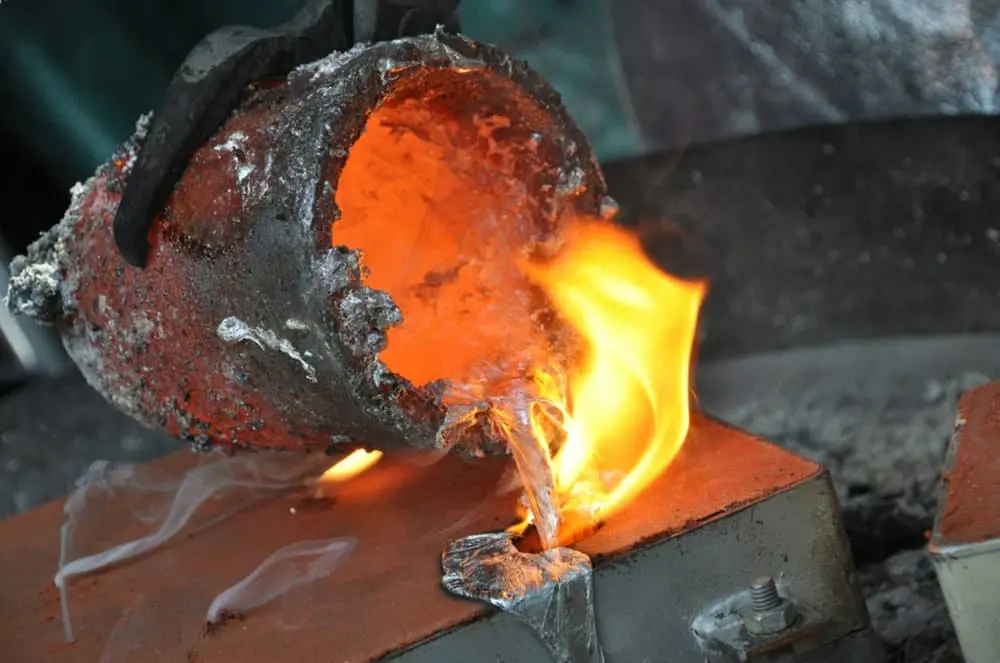
For the melting of non-ferrous and precious metals like Copper, Aluminum, Gold, and Silver, the Graphite Crucible is often the vessel of choice. In an induction heating environment, it is not merely a “container” but a critical link in the conversion of thermal energy.
1. Core Physical Properties Analysis: Why Choose Graphite?
In induction furnaces, the efficiency of graphite crucibles is attributed to two core characteristics: Electrical Conductivity and Thermal Conductivity.
Electrical Conductivity — “It is a Heating Element”
In induction melting, this is a crucial concept.
- Inductive Coupling: Graphite is a good conductor. When the induction coil is energized to generate a magnetic field, the magnetic field lines cut through the crucible wall, generating powerful Eddy Currents within the wall itself.
- Self-Heating Effect: Even if the metal inside (such as scraps or powder) is discontinuous or has poor conductivity, the graphite crucible itself will heat up rapidly due to the Joule heating caused by resistance.
- Advantage: This means the crucible effectively becomes a “heating body,” transferring heat to the internal metal via conduction. This is vital during the initial melting stage (especially when adding cold or fine materials).
Thermal Conductivity — “Efficient Heat Transmission”
- Rapid Uniform Heating: High-quality graphite crucibles (often with added Silicon Carbide/SiC) possess extremely high thermal conductivity. They quickly transfer the induction-generated heat to the metal inside, significantly shortening melting time and reducing energy consumption.
- Temperature Uniformity: Good thermal conductivity helps reduce temperature gradients across the crucible walls, thereby lowering thermal stress caused by local overheating.
2. Melting Considerations for Specific Metals
- Copper (Cu) & Aluminum (Al): The melting volume is usually large. For Aluminum, attention must be paid to degassing and dross removal. The chemical inertness of graphite prevents the molten aluminum from being contaminated by the container (unlike iron crucibles, which increase iron content in aluminum).
- Gold (Au) & Silver (Ag): Precious metal melting prioritizes purity and zero loss. Graphite crucibles have a smooth surface with low wettability (metal does not stick to it), resulting in minimal residue after pouring, making them perfect for high-value metals.
3. Three Major Maintenance Enemies: Oxidation, Moisture, Thermal Shock
Although graphite crucibles are heat-resistant, they are brittle like ceramics, flammable like carbon at high temperatures, and absorbent like a sponge. Here is the protection guide:
A. Prevent Moisture Absorption — Avoid “Explosions”
The graphite structure is microporous and easily absorbs moisture from the air. If a crucible containing moisture is heated rapidly, the water turns into steam and expands in volume, causing the crucible to spall (flake off) or even explode.
- Storage Principles: Must be stored in a dry, ventilated environment with a constant temperature. Never place them directly on concrete floors (concrete draws up moisture); use wooden pallets or racks.
- Mandatory Pre-heating (Drying): Even for new crucibles or old ones left unused for a long time, moisture removal baking is required before use.
- Procedure: Keep the crucible at a low temperature range (approx. 200°C) for 1-2 hours. This is hot enough to drive out moisture without generating violent steam pressure.
B. Prevent Thermal Shock — Avoid “Cracks”
Thermal shock refers to cracks caused by uneven expansion within the material due to rapid temperature changes.
- Pre-heating Curve: After drying, do not heat at full power immediately. Ramp up the temperature linearly to 800°C-900°C (red hot) before charging the metal.
- Charging Technique (Crucial):
- Cold Material into Hot Crucible: It is strictly forbidden to wedge large cold metal ingots horizontally into the bottom or middle of the crucible.
- Expansion Difference: Metal expands much faster than graphite upon heating. If an ingot is wedged too tightly, it will act like a jack as it expands, bursting the crucible.
- Correct Practice: Pad the bottom with scrap/small pieces first, and place large blocks vertically and loosely.
C. Prevent Oxidation — Avoid “Thinning and Leaking”
The main component of graphite is carbon, which begins to oxidize (burn) upon contact with air above 400°C – 600°C, producing carbon dioxide. Oxidation causes the crucible walls to thin, lose strength, and suffer reduced thermal conductivity.
- Protective Glaze: Quality crucibles are coated with an anti-oxidation glaze. Handle with extreme care; do not bump or scratch this protective layer.
- Covering Agents: During melting, minimize the time the molten surface is exposed. Use covering agents (charcoal, flux, etc.) to isolate air, or use inert gas protection (depending on the process).
- Avoid Prolonged Empty Burning: If a crucible is held at red heat without molten metal inside, exposing it directly to air causes the fastest oxidation. After melting, clean and cool naturally as soon as possible, or leave a small amount of “heel” (residual metal), if the process allows.
- Cleaning Slag: Clean the slag/dross hanging on the crucible walls daily. Certain acidic or alkaline slags will chemically erode the graphite glaze, accelerating oxidation. Note: Be gentle when cleaning; do not chisel into the crucible body.
4. Summary & Suggested Standard Operating Procedure (SOP)
To extend service life, it is recommended to establish the following SOP:
| Stage | Key Action | Purpose |
| Storage | Check for cracks, store on dry racks. | Prevent invisible damage and moisture intake. |
| Start-up | Slow bake at 200°C for 2 hours. | Thoroughly remove physically adsorbed water to prevent explosions. |
| Ramp-up | Slowly heat to red hot (800°C+). | Allow the crucible to expand uniformly and build thermal shock resistance. |
| Charging | Pad bottom with scraps; place large ingots vertically. | Avoid large ingots expanding and bursting the crucible bottom. |
| Melting | Keep liquid surface covered; avoid scraping walls when stirring. | Reduce oxidation loss. |
| Shutdown | Clean slag/dross; avoid direct strong wind cooling. | Prevent slag erosion and cold thermal shock. |