In the peak of summer, foundry and metallurgy workshops face more than just environmental heat. the “condensation phenomenon” caused by high humidity is a silent killer of medium-frequency (MF) induction furnaces. To ensure equipment doesn’t “strike” under high-load operations, a scientific summer maintenance protocol is essential.
I. Beware of Condensation: The Invisible Threat to Coil Insulation
During summer, when the cooling water temperature drops below the dew point of the workshop air, water droplets rapidly condense on the surfaces of induction coils, water-cooled cables, and capacitors.
- Fatal Risks: Accumulated moisture reduces insulation resistance between coils, leading to surface tracking (arcing). In severe cases, this causes carbonization of insulation boards and inter-turn short circuits.
- Proactive Measures:
- Dew Point Monitoring: Install hygrometers in the workshop. If humidity exceeds 80%, the inlet cooling water temperature should be maintained above 30-50℃. Avoid feeding chilled water directly into the furnace body when it is idle.
- Delayed Pump Shutdown: Do not shut off cooling water immediately after stopping the furnace. However, once the furnace body has cooled to a safe range, switch to a small circulation loop or shut it down to prevent pipes from “sweating” in the humid air.
II. Precision Control of the Cooling System
Cooling efficiency drops in the summer, but simply increasing water volume isn’t the best solution. The key lies in thermal balance.
- Temperature Differential (Delta T): The ideal difference between inlet and outlet water temperatures should be kept within 10-15℃. An excessive gap suggests insufficient flow or internal scaling; a gap that is too small may indicate that the heat exchange efficiency has hit a bottleneck.
- External Cooling Tower Maintenance:
- Regularly clean algae and scale from the cooling tower infill to ensure unobstructed airflow.
- Inspect the spray system to prevent nozzle clogs that lead to “dry zones” and reduced cooling capacity.
III. “Heatstroke Prevention” for the Power Room
MF power cabinets (utilizing SCR or IGBT technology) are extremely sensitive to ambient temperature. The failure rate of electronic components increases exponentially in high heat.
- Positive Pressure Ventilation: Keep the power room under slight positive pressure to prevent conductive dust from the workshop from drifting in.
- Forced Heat Exhaust: Install high-power centrifugal fans above the power cabinets to vent hot air from inverters and reactors directly outdoors rather than circulating it internally.
- Air Conditioning vs. Dehumidifiers:
- AC Units: Set between 25-28℃. While effective for cooling, ensure the vents do not blow directly onto electrical components to avoid localized condensation.
- Industrial Dehumidifiers: In high-humidity regions, a high-capacity industrial dehumidifier is often more effective than AC alone. Aim to keep humidity below 60% for optimal circuit board protection.
IV. Targeted Inspections of Critical Components
- Insulation Resistance Measurement: Use a Megger (insulation tester) weekly during downtime to check the insulation of the coil and power supply to the ground. Standards can be slightly relaxed in summer, but a “cliff-like” drop in values requires immediate shutdown and drying.
- Fastener Checks: Thermal expansion and contraction are more intense in summer. Regularly check water-cooled cable connectors and reactor joints for looseness to prevent high contact resistance from causing localized overheating.
- Water Quality Monitoring: High temperatures accelerate scale formation. Increase the frequency of scale inhibitor dosing and ensure the cooling water conductivity remains below 50μS/cm.
V. Emergency Protocols: Preparing for Summer Power Outages
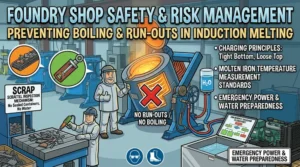
Summer is the peak season for power grid stress. A sudden outage while the furnace contains molten metal can be catastrophic.
Essential Equipment:
- Backup Diesel Generator: Must be capable of powering the emergency water pumps to maintain furnace lining cooling and prevent melt-through.
- Emergency Water Source: If a generator is unavailable, install a high-level water tank or connect to a pressurized municipal water system as a final line of defense.
By implementing this three-pronged approach of “Temperature Control, Dehumidification, and Robust Ventilation,” you can effectively avoid the electrical failures common in summer and keep your MF induction furnace productive through the heat.
Beyond the cooling water temperature, are you finding that your power cabinet filters are clogging more frequently in the summer humidity?