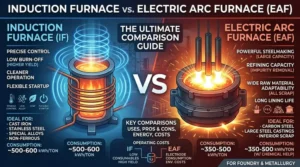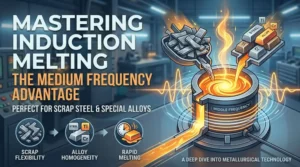
Induction furnaces can melt virtually all electrically conductive metals and alloys. They work by using electromagnetic induction to generate eddy currents inside the metal, relying on the metal’s own electrical resistance to heat and achieve fast, uniform melting.
Based on physical properties and industrial applications, induction furnaces are primarily used to melt the following major categories of metals.
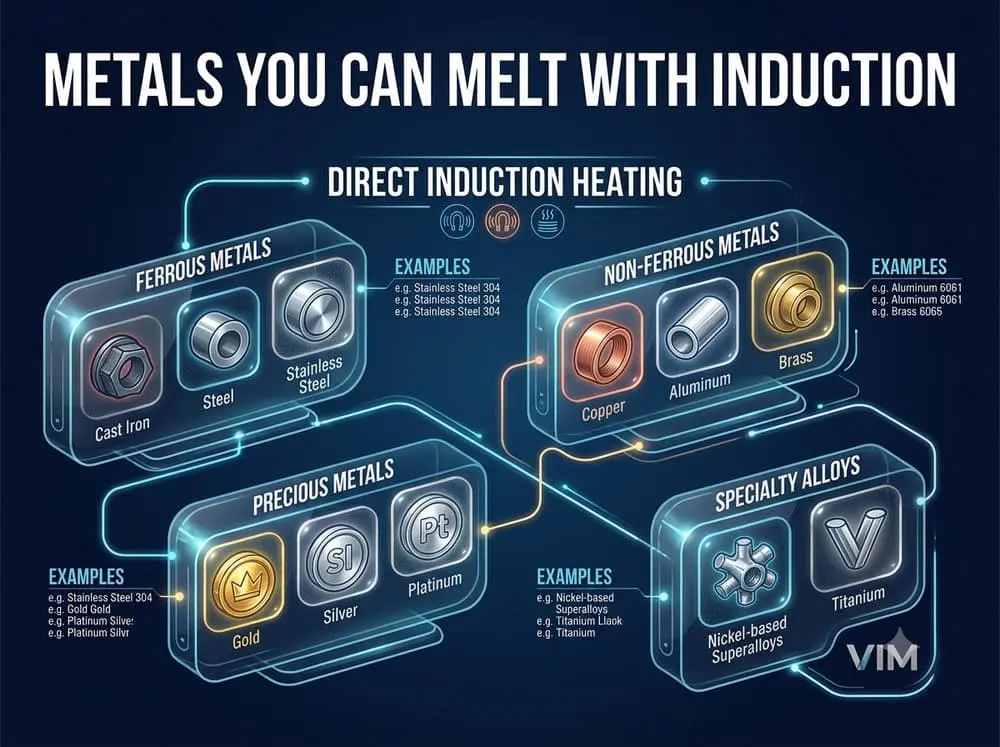
1. Ferrous Metals
Cast Iron: Widely used for melting and holding gray iron and ductile iron—one of the most common applications in foundries.
Carbon Steel & Alloy Steel: Induction furnaces provide precise temperature control and uniform alloy composition, making them ideal for melting high-quality specialty steels.
Stainless Steel: Because induction melting does not use an electric arc, it prevents carbon pick-up, making it suitable for stainless steels with strict low-carbon requirements.
2. Non-Ferrous Metals
Copper & Copper Alloys: Includes pure copper, brass, bronze, etc. Electromagnetic stirring inside the furnace ensures a uniform chemical composition.
Aluminum & Aluminum Alloys: Despite aluminum’s high thermal conductivity and lower melting point, induction furnaces (typically medium-frequency or mains-frequency) are widely used for rapid melting and scrap recycling.
Zinc, Lead, & Tin: These low-melting-point metals can be melted with exceptionally high efficiency.
3. Precious Metals
Gold, Silver, Platinum, & Palladium: Compact high-frequency or medium-frequency induction furnaces are standard in jewelry manufacturing, lab R&D, and refining. They offer precise temperature control, minimizing oxidation and volatile losses of expensive metals.
4. Special Metals & Superalloys
Nickel-Based & Cobalt-Based Superalloys: Commonly used for aerospace engine components and precision industrial equipment.
Titanium & Titanium Alloys: Highly reactive with oxygen and nitrogen at high temperatures, titanium melting must be performed in a Vacuum Induction Melting (VIM) furnace.
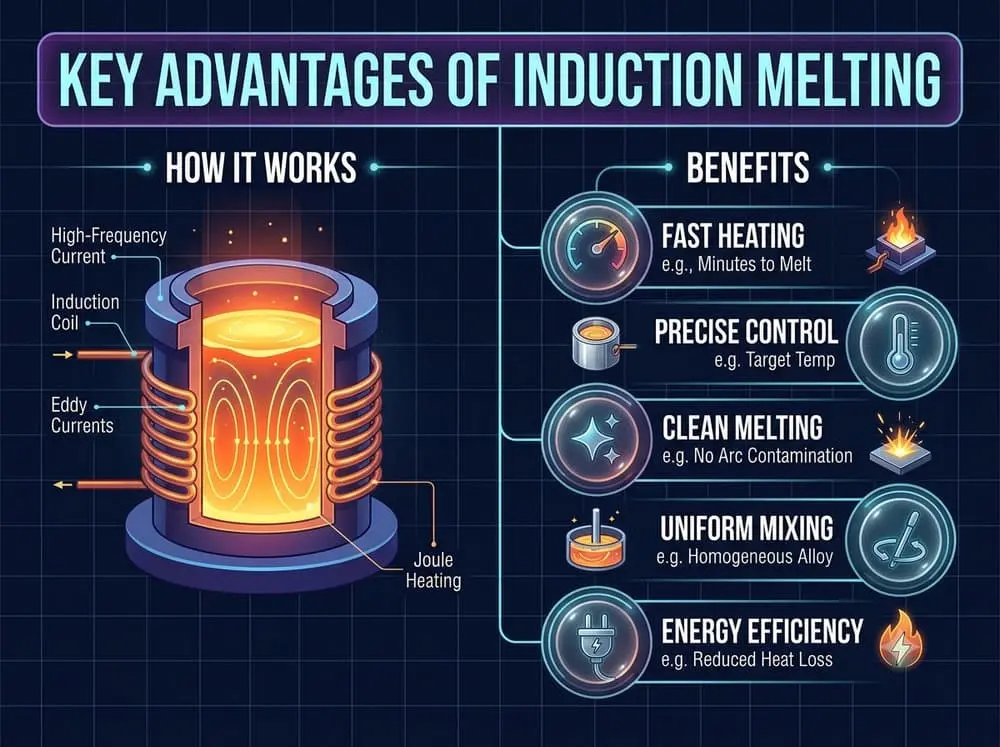
Note: Direct induction heating requires the material to be electrically conductive. To melt non-conductive materials (such as specialty glass, ceramics, or polymers), an indirect heating approach is used: a conductive crucible (such as a graphite crucible) is heated by the induction coil, which then transfers heat to the non-conductive charge inside.