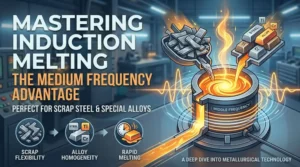
In the world of Investment Casting, choosing between a Medium Frequency (MF, 1kHz – 20kHz) and a High Frequency (HF, 20kHz – 100kHz+) induction furnace isn’t about finding the “better” machine—it’s about finding the right “match” for your alloys and material geometry.
Here is a deep dive into the technical differences that will dictate your shop’s melting efficiency and casting quality.
1. The Physics: Skin Effect and Penetration Depth
The Skin Effect dictates that induced current tends to concentrate on the surface of a conductor. The higher the frequency, the shallower the Skin Depth (δ).
- Medium Frequency (MF): Offers deeper penetration. Heat is generated further into the core of the metal, making it ideal for melting large-diameter ingots or bulky returns.
- High Frequency (HF): Heat is concentrated almost instantly on the very surface.
Technical Note: The relationship between skin depth δ and frequency f is expressed as δ ∝ 1 / √f . If you quadruple the frequency, you halve the penetration depth.
2. Electromagnetic Stirring Force
Induction isn’t just about heat; it’s about movement. This stirring action is vital for chemical homogeneity.
- MF Furnaces (Strong Stirring): Lower frequencies produce a powerful electromagnetic force that creates a visible “hump” in the melt.
- Pro: Excellent for mixing in alloying elements (like Cr or Ni) to ensure a perfectly uniform composition.
- Con: Excessive stirring can erode the crucible lining and increase gas pickup or oxidation.
- HF Furnaces (Gentle/Calm Melt): The melt surface remains relatively flat and quiet.
- Pro: Best for volatile alloys or reactive metals where you want to minimize contact with air.
- Con: Poor at dissolving heavy alloy powders or ensuring uniformity in large batches.
3. Material Compatibility: Ingots vs. Fine Scrap
This is where most shops make or break their ROI.
- The “Ingot Lover” (MF): If your charge consists of large master alloy ingots or heavy “clunky” returns, MF is your workhorse. However, it struggles to “couple” with fine metal chips or powders, often resulting in a failed start.
- The “Scrap Slayer” (HF): HF is remarkably efficient at heating small particles, thin flakes, or fine powders. In investment casting, if you deal with tiny precision parts or a lot of fine-grained scrap, HF will start and melt much faster.
4. Alloy and Application Comparison
| Feature | Medium Frequency (MF) | High Frequency (HF) |
| Best For | Carbon Steel, Stainless, Large Copper/Alu | Gold, Platinum, Dental Alloys, Micro-parts |
| Charge Weight | Typically 5kg to several tons | Typically 10g to 20kg |
| Stirring Action | Strong (Great for alloying) | Weak (Great for delicate melts) |
| Typical Use | Industrial-scale casting | Jewelry, Medical, Lab R&D |
| Crucible | Large Ceramic/Refractory | Small Graphite or Quartz |
5. Operational Nuances: Maintenance and Grid Impact
- Crucible Life: Because MF has a stronger stirring force, it physically “washes” the crucible walls more aggressively, often leading to slightly higher refractory wear compared to the gentler HF.
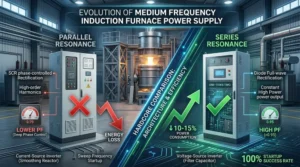
- Power Quality: High-frequency units can introduce more harmonics into your shop’s electrical grid. Modern IGBT-based MF power supplies are generally more robust and offer a power factor of 0.95+ without complex filtering.
Final Verdict: How to Choose?
- Go with Medium Frequency (MF) if:
- Your typical melt is over 10kg.
- You use standardized master alloy ingots.
- You are casting industrial components (valves, impellers, automotive parts).
- Go with High Frequency (HF) if:
- You need “lightning-fast” melts (minutes, not hours).
- You work with precious metals or high-purity specialized alloys.
- Your castings are tiny (jewelry, dental, or micro-electronics).
Pro Tip: Many modern precision shops use a “Hybrid Strategy”—MF for the main production line and a small HF unit for recycling fine sprue scrap or running small-batch R&D samples.